

A quick note before we dive into Part 4.
I took the Nutanix certification exam yesterday morning — and I didn’t pass.
No excuses, and I definitely don’t blame the test.
The training itself was excellent, and I genuinely learned a lot. From architecture to platform concepts, it did exactly what it was supposed to do.
What stood out, though, was how heavily the exam leaned into Disaster Recovery, Data Protection, and troubleshooting a live Nutanix cluster. Those topics weren’t a major focus in class, and the reality is simple: you don’t truly internalize them without hands-on, day-to-day operational experience. Slides and labs help, but production reality is a different teacher.
That experience actually frames why this part of the series matters.
In the real world, platforms aren’t judged by how elegant they look on a whiteboard or how well someone memorizes exam objectives. They’re judged by how well they:
Protect data
Recover from failure
Reduce operational risk
Make complex infrastructure simpler to run
And that’s exactly where the newly announced Nutanix + Pure Storage integration becomes compelling.
For someone like me — focused on architecture, outcomes, and operational clarity rather than exam checkboxes — this integration directly addresses the hardest parts of running modern infrastructure: reliable data services, predictable recovery, and reducing the burden on administrators who already have enough on their plates.
So while Part 4 isn’t about an exam, the lesson carries forward: real value shows up in operations, not certifications. And that’s the lens I want to use as we explore what Nutanix and Pure Storage actually deliver together.
Let’s get into it.
After watching months of product development, internal briefings, and lots of architectural “hmm… wait, why is that important?” moments, I finally get to publish this.
If you’ve read Parts 1–3 of this series, you know I’ve been grinding through Nutanix concepts from the inside out: mental models, components, behaviors, and — crucially — the details the practice exam loves to ask about. Today, we’re switching gears a bit.
This post isn’t about fault or failure. It’s about two excellent platforms choosing to work together in a way that genuinely elevates customer options — without compromising what made each so successful in the first place.
Strategic Vision: Two Leaders, One Purpose

The new joint solution between Nutanix Cloud Platform and Pure Storage FlashArray is now generally available — not an accidental add-on, not a forced integration, and certainly not a stopgap. This is the result of deliberate co-engineering between two companies with deep domain expertise and a shared commitment to simplicity, performance, and real operational outcomes. (NTNX+PSTG GA)
If you have 35 minutes to spare, watch this:
Nutanix and Pure Storage: Propelling Enterprise Virtualization Forward
Here’s what stood out to me as architecturally thoughtful:
The integration isn’t just about connecting external storage to Nutanix — it’s about elevating the storage capabilities in a way that feels native to Nutanix operations. (nutanix.com)
Every Nutanix vDisk (remember this from Part 1?) is now backed by a Pure FlashArray volume, preserving the VM-centric workflow Nutanix users expect, and avoiding user confusion about datastores or islands of management. (Pure Storage Blog)
The FlashArray brings industry-leading all-flash (NVMe) performance (no more SSD or HDD option), always-on data services (compression, dedupe, encryption), and enterprise features that are hard to replicate logically in a software-only stack. (nutanix.com)
This isn’t Nutanix “giving up” anything — it’s Nutanix expanding what it can offer while keeping its architectural identity clean and consistent.
A Modern Infrastructure Alliance
The virtualization market is changing rapidly. Licensing costs are climbing, vendor lock-in concerns are real, and IT leaders are actively seeking alternatives that give them choices without complexity. In that environment, Nutanix and Pure Storage are offering a modern infrastructure alliance that resonates with how customers actually think about infrastructure outcomes. (nutanix.com)
The solution delivers:
Performance at scale via Pure Storage’s enterprise-class NVMe architecture
Prism-centric operations, so Nutanix users don’t suddenly have to learn a second control plane
Granular VM-level data services, bringing snapshot, protection, and replication capabilities aligned with application intent
These aren’t incremental niceties — they are capabilities that modern enterprises care about in mission-critical workloads ranging from databases to AI.
Ecosystem Shifts Put This in Context
Now, let’s add ecosystem context that matters to customers contemplating virtualization strategy.
Recently, Broadcom announced the deprecation of VMware Virtual Volumes (vVols) in VMware Cloud Foundation (VCF) and VVF version 9.0, with removal planned in future releases. (Broadcom / VMware Support Portal)
vVols were once pitched as a way to tightly integrate array-level storage controls with VMware infrastructure. Their planned removal from VCF (starting with version 9) signals a shift in VMware’s long-term storage strategy and creates real questions for customers who invested a lot of effort and already built around that model.
This doesn’t diminish VMware’s presence or Nutanix’s relevance — but it does change the calculus for customers evaluating long-term storage integration approaches. In that context, an external storage strategy that is fully supported, scalable, and natively controlled via Prism becomes increasingly relevant.
That’s not marketing spin — it’s product strategy aligning to where the industry is heading.
Note: As this post was sitting in “draft” for a while as I was waiting for the exam results, there are now some news online that the vVols deprecation is delayed indefinitely, but I don’t know for sure.
What the Joint Architecture Actually Does (Without Confusing the User)
At its core, this integrated solution:
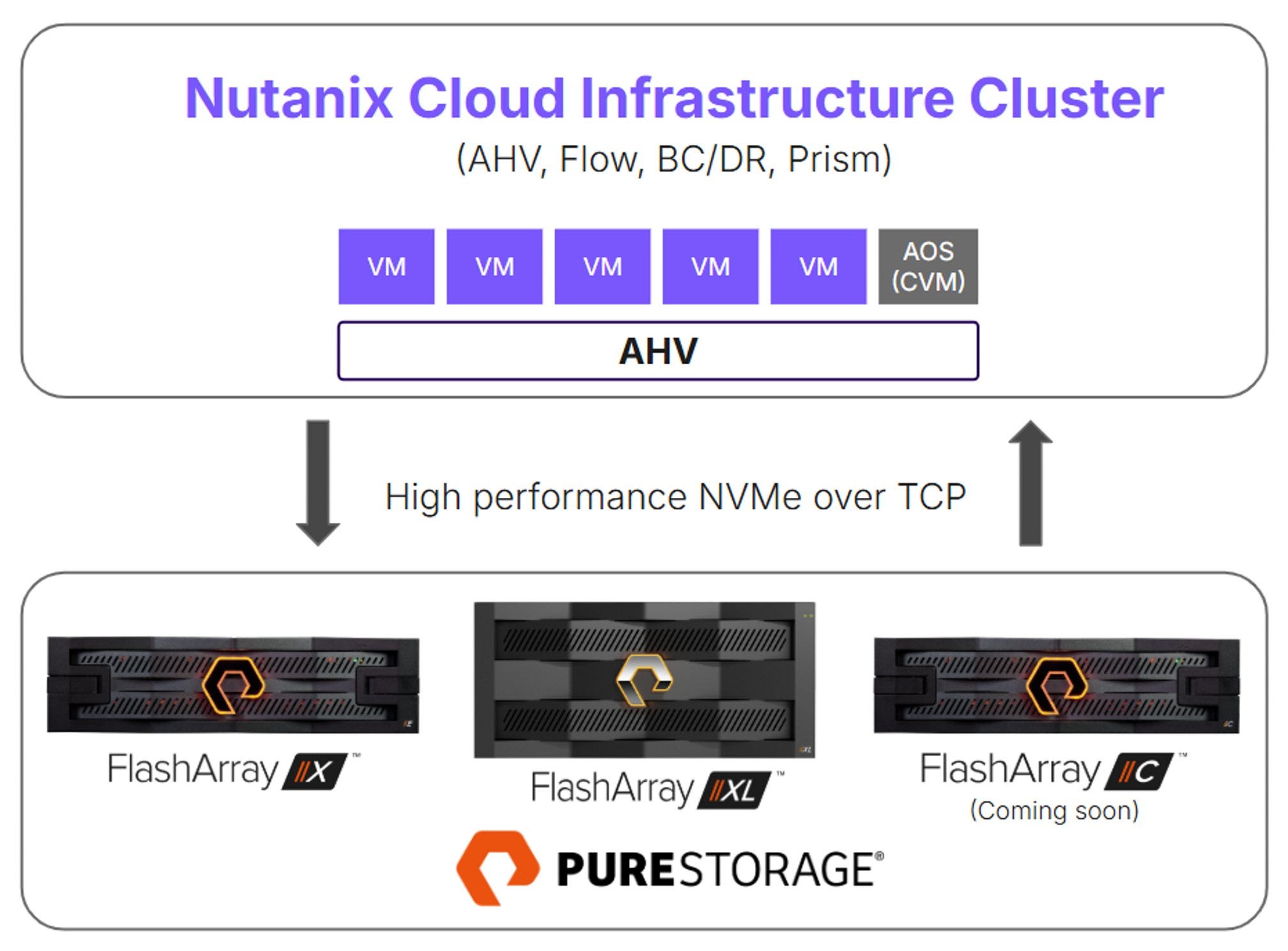
treats compute and storage as distinct but tightly coordinated layers
runs AHV on compute nodes with external storage offloaded to FlashArray
leverages NVMe/TCP for high throughput and low latency connectivity
builds per-VM storage constructs that map back to array volumes
keeps day-to-day operations in Prism Central — the interface Nutanix admins already use
Because of this design:
vaulting storage complexity underneath Nutanix Prism eliminates tool-chain sprawl
you avoid having to log into the array just to perform routine virtual infrastructure tasks
disaster recovery and protection workflows can be aligned closely with application requirements
All of this shows respect for the way Nutanix users think and operate, not just the underlying technology.
Real Customer Value (Without Canceling HCI)
One of the most important elements of this solution is that it does not require customers to abandon what they’ve already built.
Whether:
you’re a Nutanix shop adding FlashArray for performance and scale,
a Pure Storage customer thinking about virtualization strategy,
or a customer in transition away from a legacy solution,
The integration supports preserving existing investments while expanding capabilities. (nutanix.com)
That’s not cheap marketing language — it’s real architectural benefit.
Operational Practicality and Compatibility
This isn’t just a concept; it’s engineered with real installation considerations in mind:
Support begins with a clear hardware and software baseline for production use
The architecture scales predictably — both for compute and storage
Workload placement and cluster behavior remain consistent with Nutanix semantics
And array-level capabilities like replication and SafeMode snapshots are ported into enterprise continuity workflows
This tells me the engineering teams weren’t just solving connectivity — they were solving for predictable, sustainable operations.
Final Thoughts (a.k.a. My #dmitrywashere Take)
Here’s the bottom line:
This partnership is not a commentary on the “limitations” of HCI — far from it. Nutanix’s HCI architecture has been successfully powering thousands of enterprise deployments because it delivers simplicity, consistency, and strong operational models.
What this integration does is offer another dimension of choice, not a replacement for that model. It respects the strengths of both platforms and gives customers a third option: combine Nutanix’s operational simplicity with Pure Storage’s storage excellence — without complexity, without re-architecting how you manage your virtual infrastructure.
In an industry that too often treats change as an excuse for disruption, this partnership treats change as an opportunity for evolution.
— Dmitry
#dmitrywashere