

Over the past several months, I have interviewed dozens of candidates for pre-sales systems engineering roles. Some were early in their careers, still learning how to tell their story. Others were seasoned professionals with long resumes, customer-facing experience, leadership exposure, and enough years in the business world to know how interviews usually work.
Out of all of them, only one sent a thank-you note after the interview.
One.
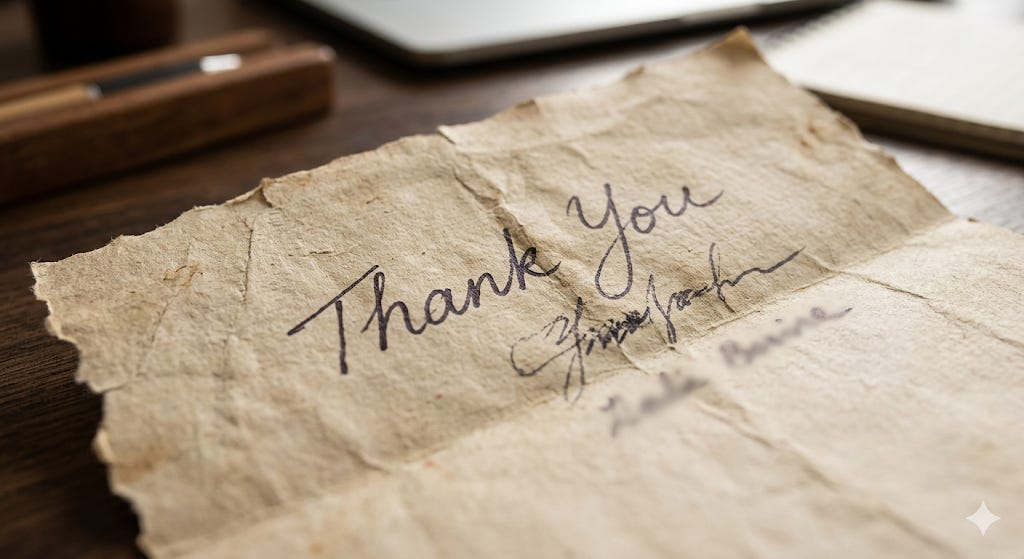
At first, I almost dismissed my own reaction. Maybe I was being old-fashioned. Maybe the post-interview thank-you note had quietly become one of those business traditions that aged out of relevance, like printed directions, fax cover sheets, or wearing a suit on an airplane. Maybe people no longer see it as necessary. Maybe recruiters are overwhelmed, candidates are applying to too many roles, and everyone has silently agreed that the interview ends when the Zoom window closes.
But the more interviews I did, the harder it became to ignore. This was not just a younger generation thing. It would be easy, and lazy, to turn this into another “kids these days” complaint, but that would miss the point completely. Some of the people who skipped the follow-up were experienced professionals. People who have been in customer meetings. People who have worked with executives. People who should understand that a professional conversation does not always end the moment the scheduled time is over.
And it was not only the missing thank-you notes.
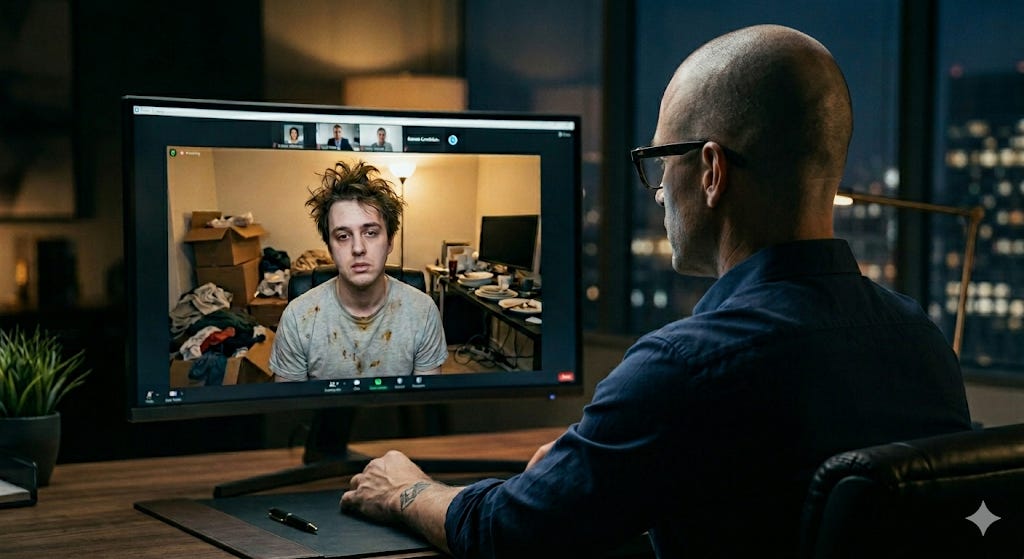
I started noticing the way people showed up on camera. Again, I am not talking about suits and ties. I do not need anyone to perform some outdated corporate costume to convince me they are serious. But there is a difference between relaxed and unaware. There is a difference between casual and careless. When someone joins a professional interview in a T-shirt or sweatshirt, from a messy room, looking like the conversation interrupted something else they were doing, it sends a signal. Maybe not the signal they intended, but a signal nonetheless.
That is where this topic becomes more interesting than a simple complaint about manners.
Because I do not think business etiquette has simply disappeared. I think we are living through a strange transition where the old signals of professionalism are fading faster than the new ones have been clearly defined. The suit matters less. The formal email matters less. The perfectly structured follow-up matters less.
But respect still matters.
Preparation still matters.
Situational awareness still matters.
The ability to make another person feel that the interaction was worth your attention still matters.
The problem is that we used to package all of those things inside visible rituals. Dress a certain way. Write a certain way. Send the note. Use the formal greeting. Recap the meeting. Capitalize the sentence. Sign the email. None of those behaviors automatically made someone competent, but they were familiar indicators. They told the other person, fairly or unfairly, that you understood the environment you were in.
Now many of those indicators have been stripped away.
Some of that is good. The old version of professionalism had plenty of nonsense built into it. It often rewarded polish over substance and performance over authenticity. It confused stiffness with discipline and formality with competence.
Many people adapted and learned how to look professional without necessarily being thoughtful, prepared, accountable, or useful. They knew the costume, the vocabulary, the posture, and the email format, but not always the judgment behind it.
Remote work accelerated the collapse of that theater. Once we all started seeing each other in spare bedrooms, kitchens, basements, and home offices, the clean separation between the work self and the real self became harder to maintain. Dogs barked. Kids walked into the room. Doorbells rang. Wi-Fi failed. People took calls from cars, hotel lobbies, and kitchen tables. The polished corporate stage became a little more human, and in many ways, that was a healthy correction.
I am not suggesting we return to a world where someone’s professionalism is judged by whether they wear a jacket on Zoom or whether their email contains the correct number of corporate pleasantries. I do not think a candidate should be rewarded for sending a generic thank-you note that says nothing beyond “thank you for your time and consideration.” That kind of note is polite, but it is also forgettable. In some ways, it may even be worse than no note at all because it proves the person knows the ritual but did not put any real thought into it.
But I also do not think we should pretend that effort no longer matters.
That is the part that seems to be getting lost.
A thoughtful post-interview note is not about obedience. It is not about begging for a job. It is not about corporate brown-nosing. At its best, it is a continuation of the conversation. It gives the candidate one more chance to show that they listened, understood the challenges discussed, and connected their experience to the actual needs of the role. It is a small act, but small acts are often where judgment shows up.
The best follow-up does not need to be long. It does not need to sound like it was copied from a career advice website or was generated by an LLM. In fact, it should not. It should simply make the other person feel that the time spent together landed somewhere. It can be as simple as a sentence about something specific from the conversation, a clear restatement of interest, or a relevant thought that connects back to the business problem, the team dynamic, or the customer challenge discussed during the interview.
That is not old-fashioned.
That is professional.
The same thing applies to showing up on video. I am not asking for theater. I am asking for awareness. If you are interviewing for a role where you may represent the company in front of customers, partners, executives, or your own team, then how you show up in the interview matters because it gives people a small preview of how you may show up later. Not a perfect preview, but a useful one.
Nobody is expecting perfection. We all have real lives. Things happen. Cameras fail. Backgrounds are imperfect. But the person on the other side of the screen can usually tell the difference between someone who made an effort and someone who did not think effort was required.
That distinction matters more than the clothing itself.
This is where the broader shift in workplace etiquette becomes complicated. We are no longer arguing about whether people should follow the old rules. Many of the old rules deserved to be questioned. The better question is whether we are replacing them with anything meaningful.
I think the workplace has changed faster than our shared expectations have. Messaging tools have made communication shorter and more casual. AI tools now generate meeting summaries that sound useful but often miss the real texture of the conversation. Emails increasingly resemble text messages, with missing punctuation, lowercase sentences, and a tone that can be either friendly or careless depending on who is reading it. Younger workers often interpret formality as stiff or fake, while older workers may read casual communication as lazy or disrespectful. Both sides may be reacting honestly from their own frame of reference.
The result is not simply a decline in etiquette. It is a mismatch of signals.
A lowercase message in a team chat may feel warm and approachable to one person, while another person reads it as careless. A short Slack response may feel efficient to the sender, while the recipient experiences it as abrupt. An AI-generated meeting summary may appear to save time, but if it misses the customer’s hesitation, what was left unsaid, the political tension in the room, or the real owner of the next step, then it did not save time at all. It simply moved the work from human understanding to later cleanup.
That is one of the quiet risks in the modern workplace. We are automating the artifacts of professionalism without always preserving the judgment behind them.
A meeting recap was never just a record of what was said. A good recap showed what mattered. It confirmed alignment, documented assumptions and risks, clarified ownership, captured nuance, and gave people confidence that the conversation had been understood. It did not need to be long, but it needed to be thoughtful. When the follow-up becomes a transcript link, a generic AI summary, or a dashboard no one opens, the organization may feel more efficient while actually becoming less aligned.
The same is true with communication in general. Speed is useful only when it improves clarity. Casualness is useful only when it improves connection. Authenticity is useful only when it does not become an excuse for thoughtlessness.
That may be the new etiquette test.
Not whether you followed the old ritual exactly, but whether your behavior made the interaction easier, clearer, and more respectful for the other person.
That test applies across generations. It applies to candidates, managers, sellers, engineers, executives, and anyone else whose work depends on trust. In some situations, a quick message is enough. In others, a more careful note is required. Sometimes a sweatshirt on Zoom is completely fine. Other times, it may show that you misread the moment. Sometimes an emoji softens a message. Other times, it makes a serious topic feel unserious. Sometimes AI notes are helpful. Other times, they remove the very judgment that made the meeting valuable.
The skill is knowing the difference.
That is why I keep coming back to the thank-you note. Not because I am nostalgic for some older version of the workplace, but because it is such a simple example of the larger issue. The note itself is not the point. The instinct behind it is the point.
Did you notice the human being on the other side of the process?
Did you understand that an interview is not just a transaction?
Did you take one extra step to close the loop?
Did you reinforce the value you could bring, based on what was actually discussed?
In a customer-facing role, that instinct matters. In a leadership role, it matters even more. So much of business depends on the ability to read the room, follow up thoughtfully, and make people feel that their time and priorities were understood. Those are not decorative skills. They are operating skills.
This is where I think the conversation about modern professionalism needs to land. We do not need to bring back rigid corporate formality. We also should not lower the bar so far that every careless behavior gets excused as “I am just so busy.”
There is a better middle ground, but it requires being more explicit about expectations instead of assuming everyone grew up with the same unwritten rules.
The old world often asked people to look professional. The new world should ask people to act with professional judgment.
That is a better standard, but also a harder one. Looking the part can be taught quickly. Judgment takes longer. It requires understanding context, audience, timing, and impact. It requires knowing when to be informal and when to slow down. It requires recognizing that the same message can land differently depending on the recipient, the situation, and the stakes.
It also requires humility from those of us who grew up with the older rules. Not every change is a decline. Not every casual message is disrespectful. Not every missing capital letter means the person is lazy. Not every candidate who skips a thank-you note is unqualified. Some of the old expectations were arbitrary, exclusionary, or simply inefficient.
But humility should go both ways.
Not every tradition is empty. Not every professional courtesy is outdated. Not every expectation of preparation is performative. Some rituals survived for a reason because they helped people signal respect before trust had been fully built.
That is really what etiquette does at its best. It gives people a way to create trust in moments where trust is still forming.
An interview is one of those moments.
A first customer meeting is one of those moments.
A difficult internal conversation is one of those moments.
A follow-up after a meeting where commitments were made is one of those moments.
In those situations, professionalism is not about pretending to be someone else. It is about being aware that the other person is deciding, consciously or not, whether they can trust you with something important.
That is why I still notice the missing thank-you note.
Not because I need to be thanked.
Because I am paying attention to whether the candidate is paying attention.
There is a difference.
Professionalism did not die; it just stopped wearing a tie.
And now we have to be much more intentional about what replaces it.
Appreciate you reading.
Dmitry Gorbatov
© 2025 Dmitry Gorbatov | #dmitrywashere
So, did the note-writer get the job?