

Recent developments in the industry have forced me to spend a lot more time reading, researching, learning and trying to understand a completely different side of the conversation - the financial side. And since my goal is to help people make sense of what is happening around them, I figured I should take one for the team.
By “the team,” of course, I mean my followers and, yes, all 107 Substack subscribers. So if you are one of those 107, please know that I walked willingly into the land of finance and procurement jargon on your behalf.
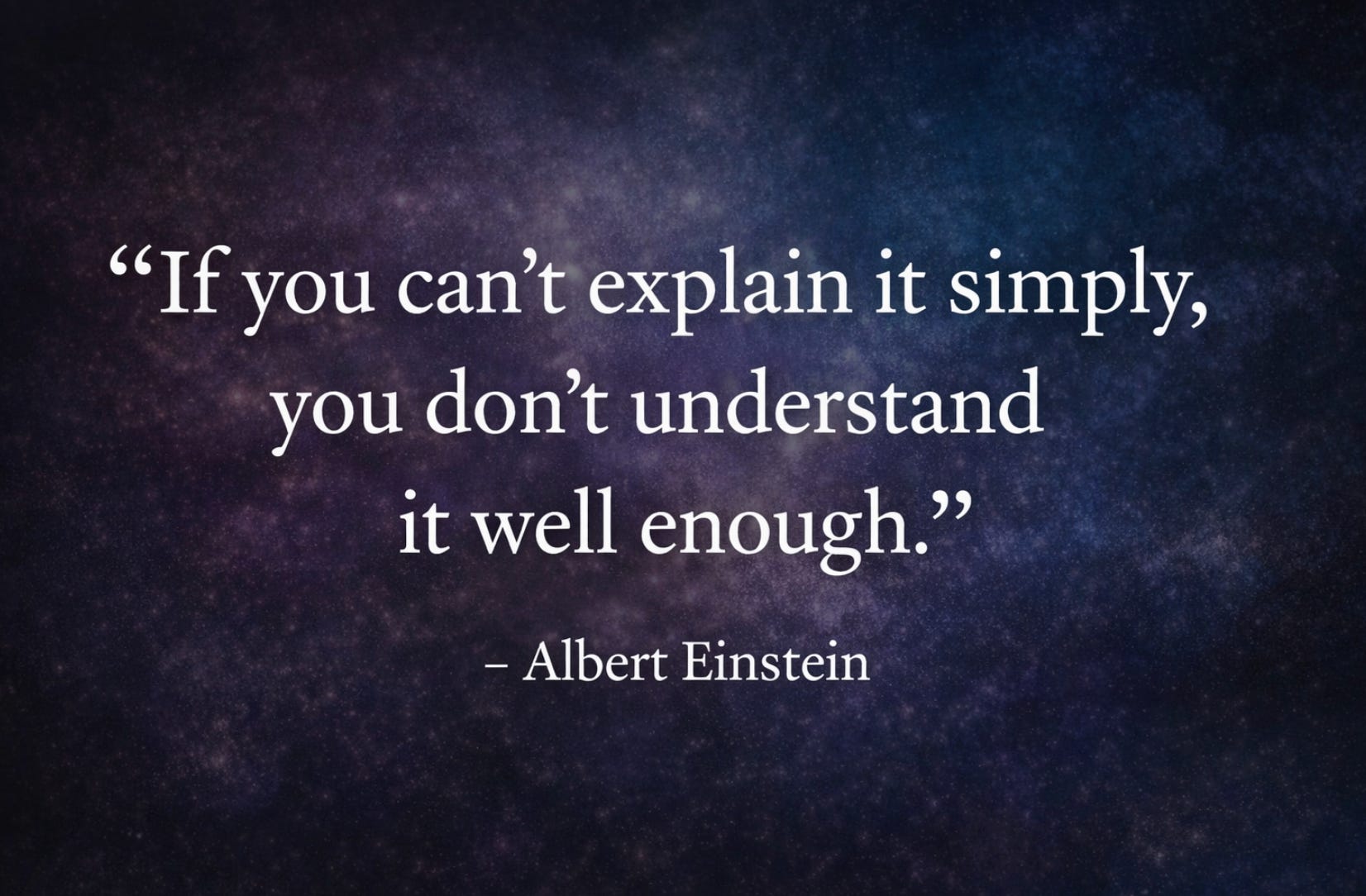
There’s a concept often attributed to Albert Einstein. There are many discussions on Reddit arguing about whether he really said it.
Simon Sinek supposedly said that “if your ideas are simple enough to understand, they become simple enough to repeat — and that’s how they spread”.
The challenge is that this topic is not naturally simple.
It sits at the intersection of semiconductor supply chains, DRAM and NAND pricing, capital allocation, procurement timing, and financial concepts that, if I am being honest, I have never considered the fun part of technology. I have always enjoyed writing about architecture, technical strategy, and what makes top-performing pre-sales systems engineers and teams actually work. That is the stuff I gravitate toward naturally.
If I’m being honest, I don’t wake up in the morning thinking, ‘let me go study finance today’.
Depreciation schedules. Capital exposure. Net Present Value. The kind of material that can make even an otherwise healthy person start looking for a distraction.
The good news is that underneath all of this complexity, there is actually a very simple shift happening.
And once you see it, it becomes hard to ignore.
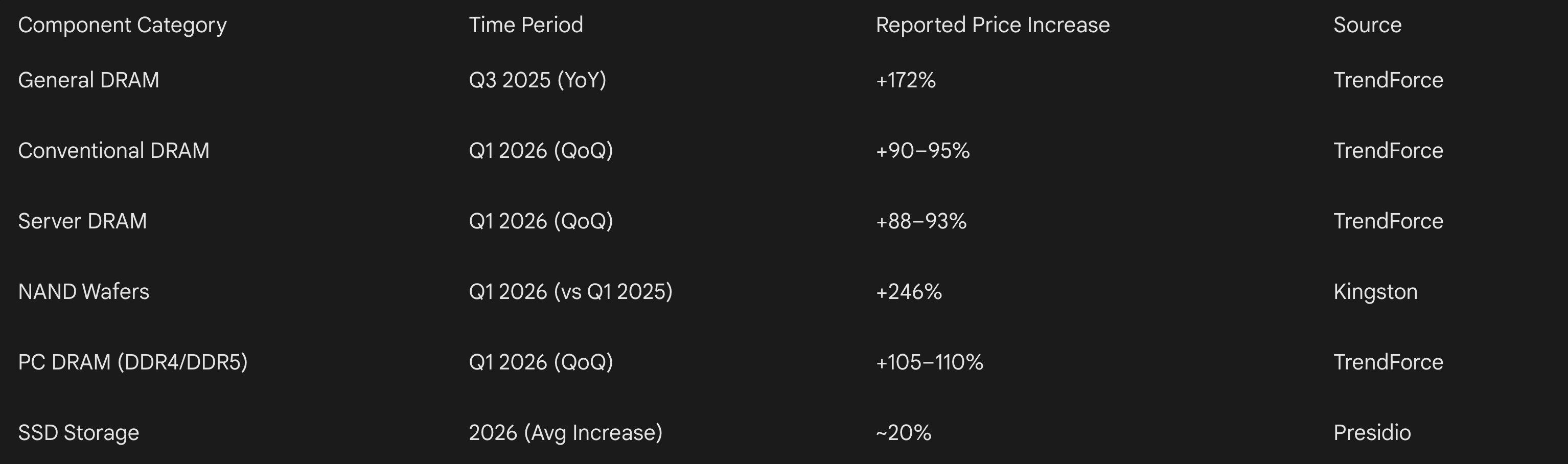
What we are experiencing is not another cyclical fluctuation in NAND or DRAM pricing. It is a structural shift in how semiconductor capacity is allocated globally.
The rise of AI has not simply increased demand; it has fundamentally reshaped prioritization across the supply chain. High Bandwidth Memory and next-generation DRAM are now absorbing the majority of advanced manufacturing capacity, leaving traditional enterprise components competing for what is effectively a constrained and not-as-important supply pool.
Memory & Flash Crisis Update (March 2026)
It is estimated that by the end of this year, AI-driven infrastructure consumes the majority of high-end memory production.
Deloitte - 2026 Global Semiconductor Industry Outlook
This creates a cascading effect across the market: longer lead times, accelerated end-of-life timelines for legacy components, and pricing volatility that can shift significantly within a single month. In this environment, the challenge is no longer selecting the “right” infrastructure platform. The challenge is making a business decision that remains rational under uncertainty.
Where the Traditional Model Fails
The traditional CapEx procurement model was always based on predictability. It assumes that organizations can make a large upfront investment, amortize it over time (or depreciate, if that word makes more sense to you), and extract consistent value throughout the lifecycle of the asset.
In a stable market, this model is manageable. In a volatile one, it becomes a source of risk.
The first failure point is timing.
In a market where DRAM prices can increase 50% or more quarter-over-quarter, the moment of purchase becomes super important. A decision made at the wrong point in the pricing curve effectively locks an organization into an elevated cost basis for the entire lifecycle of the infrastructure. Unlike other investments, there is no opportunity to rebalance or exit; the capital is committed, and the asset is fixed.
The second issue is over-provisioning.
In my last post The Idea That Was Supposed to Fail, I wrote about SSD over-provisioning. This time around, it’s a different kind.
Because procurement cycles are slow and expansion can take months — if not longer — architects are forced to design for future peak demand. This causes inefficiency: expensive infrastructure that remains underutilized for a long period of time. In today’s market, this inefficiency is magnified by elevated component costs. Organizations are not just overbuying — they are overbuying at historically high prices.
The third challenge is the accumulation of technical and financial debt.
As systems age, maintenance costs increase, performance becomes less aligned with modern workloads, and the eventual refresh becomes both inevitable and disruptive. In a constrained supply environment, that refresh is no longer a routine event; it is a new exposure to pricing increases, availability risk, and architecture that can no longer do the job.
Combined together, these factors transform what was once a simple procurement model into a series of compounded financial risks.
Reframing Infrastructure Through a Financial Lens
What I am discovering is that to navigate this environment effectively, infrastructure decisions must be evaluated not only in terms of performance and capacity, but through the lens of financial outcomes.
Please don’t feel like you need a PHD in finance from NYU Stern or The Wharton School here.
I know the next couple of paragraphs would make you feel like you need a nap or a double espresso. I am really trying to make it easy to understand.
Concepts such as cash flow timing, capital allocation, and risk-adjusted return are no longer abstract financial constructs; they are central to infrastructure strategy.
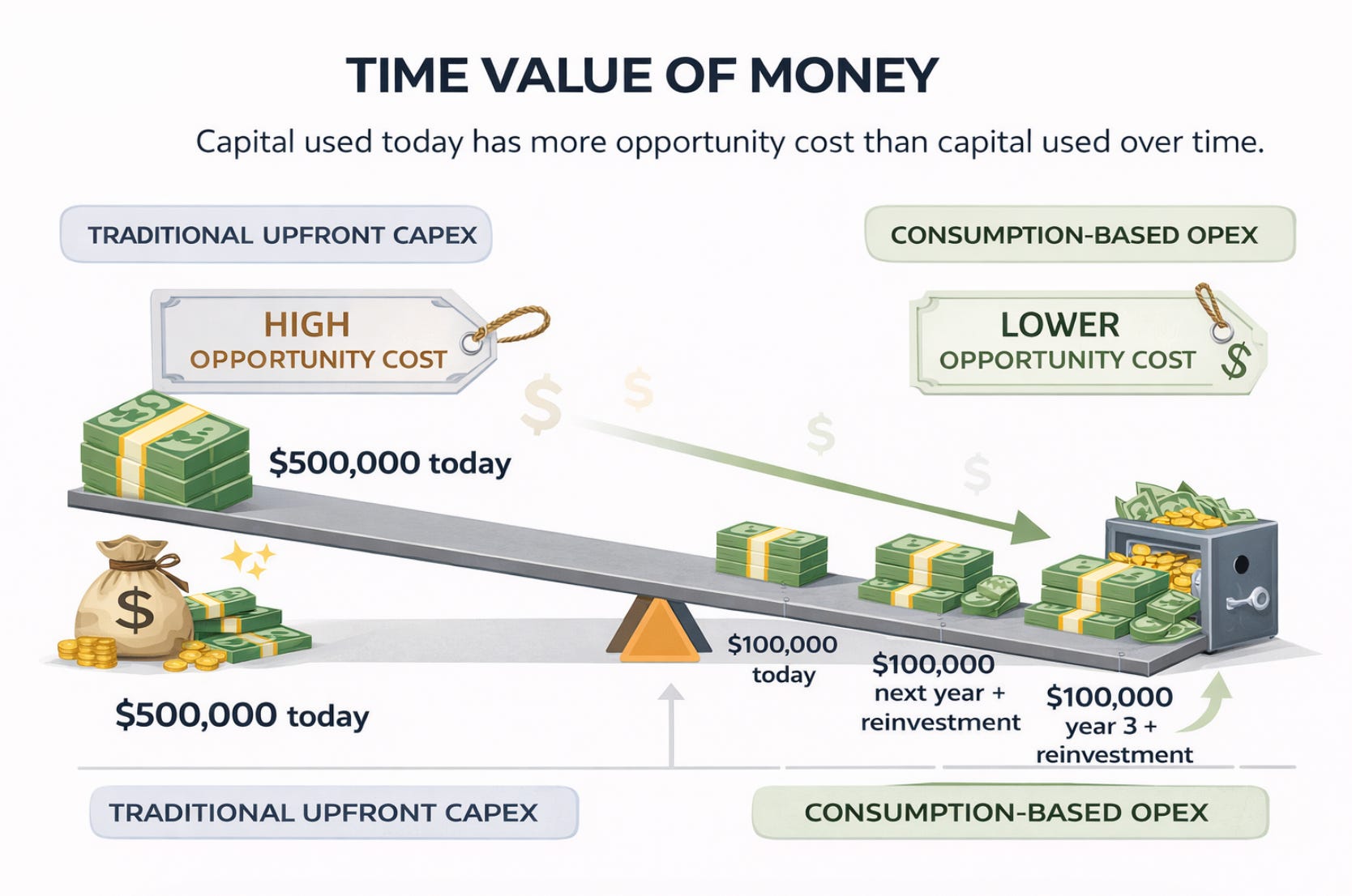
At its core, the time value of money introduces a simple but powerful idea: money deployed today carries a higher opportunity cost than capital deployed over time. In a traditional model, the majority of the money is spent upfront, reducing financial flexibility and limiting the organization’s ability to invest in higher-return initiatives. In contrast, a consumption-based model distributes that expenditure, preserving capital and allowing it to be allocated more dynamically.
This directly impacts Net Present Value (NPV), not as an academic metric, but as a practical measure of decision quality. Even when the nominal cost of a subscription model appears higher over a multi-year period, the ability to defer expenditure, accelerate value realization, and avoid unused capacity often results in a more favorable financial outcome when evaluated over time.
Net Present Value (NPV): A Guide to Smarter Financial Decisions
Equally important is the role of uncertainty. Traditional procurement assumes that future requirements can be accurately predicted. In reality, infrastructure demand is inherently variable. Data growth, application requirements, and technological shifts rarely follow a linear path. When organizations commit to fixed assets, they assume the risk of being wrong — either by over-investing in unused capacity or underinvesting and facing constraints at critical moments.
A consumption-based model fundamentally changes this dynamic by transferring a significant portion of that risk to the solution provider.
Subscription as a Risk Management Strategy
If you understand it correctly, subscription consumption of the infrastructure is not simply a different purchasing model. It is a mechanism for managing uncertainty.
And if that sounds familiar, it should. We already bought into this model years ago. We just called it “cloud-first” back then. The pitch was identical — stop making big capital bets, shift the risk, and consume what you need when you need it.
The most immediate impact is on cash flow.
Instead of a large upfront capital commitment, organizations move to a predictable, recurring expense aligned with actual usage. This improves budget predictability and reduces the friction associated with large capital approvals, particularly in environments where funding cycles are rigid.
More importantly, it removes the need to make a single, high-stakes decision at a specific point in time. In a volatile semiconductor market, this alone represents a meaningful reduction in financial exposure and business risk.
The second impact is on utilization.
By aligning cost with the actual consumption, organizations eliminate the inefficiencies associated with over-provisioning. Capacity is no longer purchased in anticipation of future demand but consumed as needed. This shifts the economic model from one of speculation to one of alignment.
The third and most significant impact is on risk.
Pricing volatility, supply chain constraints, and technical debt do not disappear, but they are absorbed by the provider rather than the customer. If you really think about it, the subscription model acts as a financial hedge against market instability.
Why the Everpure Model Changes the Conversation
Not all subscription models are created equal. The effectiveness of the approach depends on how well it aligns cost, performance, and risk.
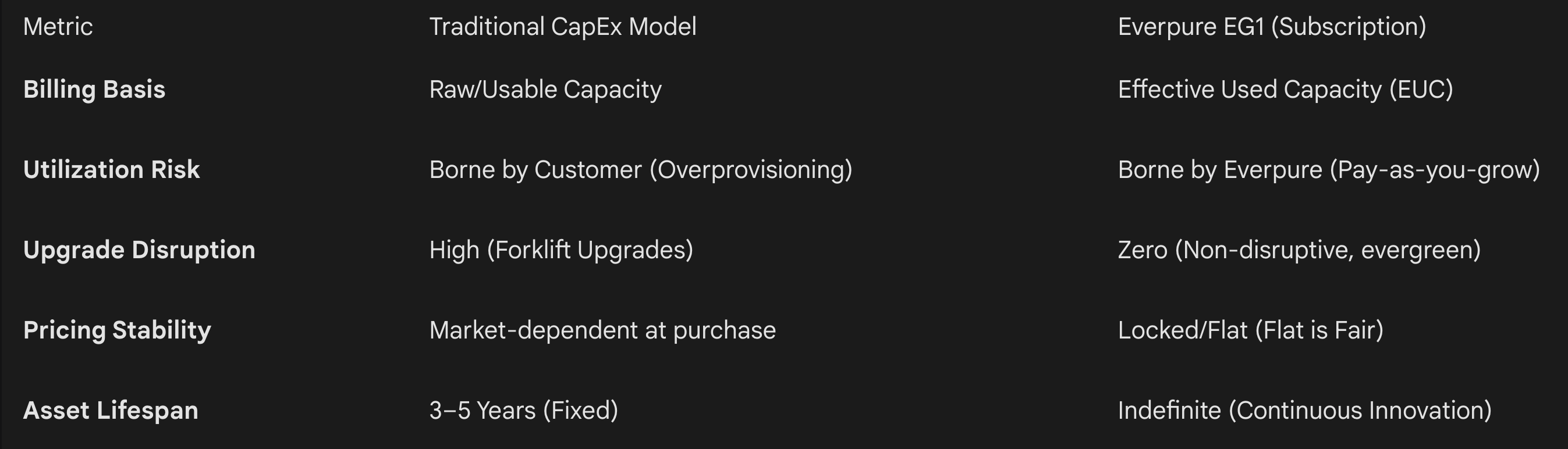
The Everpure Evergreen//One model introduces several mechanisms that directly address the challenges outlined above.
First, the concept of Effective Used Capacity (EUC) fundamentally changes how value is measured.
Rather than billing based on raw or provisioned capacity, the model aligns cost with actual data written.
This eliminates an inefficiency in traditional storage economics, where customers effectively pay for system overhead and unused capacity.
Second, the inclusion of an on-site 25% capacity buffer addresses a problem that is often overlooked in financial discussions: lead time risk.
In a market with extended delivery lead times where acquiring additional hardware can take up to a year, the ability to scale immediately is not a convenience — it is a requirement. By maintaining available capacity in advance, the model removes the dependency on unpredictable supply chains.
Third, price protection becomes a central feature rather than an afterthought.
In an environment characterized by rapid cost fluctuations, the ability to maintain stable pricing over time provides a level of budget predictability that is otherwise difficult to achieve. This is particularly relevant in public sector environments, where financial planning horizons extend beyond the volatility of the underlying market.
Finally, the elimination of disruptive upgrade cycles addresses both operational and financial inefficiencies.
Continuous, non-disruptive operations ensures that infrastructure remains current without requiring you to spend more money. This removes the “forklift upgrade” as a recurring source of cost and disruption risk.
If you want to learn more, please read this blog:
How Evergreen//One Storage Subscriptions Protect Your IT Budget from Price Spikes
Implications for the Public Sector
These considerations are critical in public sector organizations, where procurement cycles are long, budgets are fixed, and accountability is high.
Navigating IT Procurement Challenges in the Public Sector
The traditional model forces state agencies, municipalities and universities to make decisions based on assumptions that may no longer hold by the time implementation occurs. In a rapidly changing market, this creates a structural mismatch between planning and execution. Subscription models, by aligning cost with usage and providing predictable pricing, offer a way to bridge that gap.
Additionally, the ability to consume infrastructure as a service simplifies compliance and improves transparency. Costs are directly tied to measurable outcomes, reducing the complexity associated with large capital purchases and multi-year depreciation schedules.
Time-to-Value as a Financial Multiplier
One of the most under appreciated aspects of this shift is the impact on time-to-value. In traditional environments, delays in procurement, deployment, and scaling can significantly extend the time between investment and business outcome.
In a consumption-based model, that interval is compressed. Resources can be provisioned quickly, expanded without delay, and upgraded without disruption. This accelerates the realization of value, which in turn improves the overall financial profile of the investment.
From a financial perspective, earlier value is inherently more valuable. This is not a theoretical concept; it is a direct consequence of how capital is evaluated over time.
A Structural Shift, Not a Trend
Most technology sellers still position subscription as a “by the way” option — something they introduce after walking through the traditional purchase. It gets framed as a different way to buy. That framing is not just incomplete — it’s misleading. This isn’t about preference. It’s about a structural change in how organizations manage risk and make financial decisions.
What has changed is not simply how infrastructure is consumed, but the economic environment in which it exists.
Semiconductor volatility, driven by structural demand shifts, has introduced a level of uncertainty that traditional models are not designed to handle.
In this context, the question is no longer which platform offers the best performance or capacity metrics. The question is which model provides the greatest resilience — financially and operationally — in an unpredictable environment.
The answer, increasingly, is not to own the asset, but to manage the outcome.
For years, we optimized infrastructure decisions around performance, scale, and architecture. Those still matter.
But they are no longer the hardest part of the problem.
The hardest part is understanding the financial consequences of when you buy, how you buy, and what risk you take on when you do.
That’s what changed.
And once you see it, it’s very hard to go back.
Appreciate you reading.
Dmitry Gorbatov
© 2025 Dmitry Gorbatov | #dmitrywashere
We are up to 108!!!