

In my last article, The Hall of Mirrors, I wrote about what happens when AI-generated content becomes part of the data that other AI systems consume.
A meeting summary becomes a document. The document gets indexed. Another model retrieves it, summarizes it again, and saves the new version somewhere else. Eventually, the organization has several polished versions of the same event, each one separated a little further from the original conversation, decision, or human memory.
At some point, nobody remembers which version was the source and which version was generated from it.
That was the hall of mirrors.
Since writing it, I have been thinking about the machine standing in the middle of that hall.
We talk about large language models as though there is something inside them reading the prompt, considering the evidence, forming an opinion, and then carefully choosing the right words. The interface encourages this impression.
The machine says “I think.” It apologizes. It reflects. Some models now visibly pause before answering and displaying “Thinking,” which is a particularly effective way of making software look like it has gone into another room to think things over.
Many of us use these systems every day. They can be enormously useful. I also know how easy it is to forget what is actually happening behind magical closed doors.
There is no tiny researcher behind the screen consulting a library, only advanced math running across enormous models trained on staggering amounts of language.
That does not make the technology less impressive. In some ways, it makes it more impressive. We built a machine that predicts language so well that humans instinctively begin treating it as another human.

The problem begins when we confuse the quality of the performance with the nature of the performer.
What the Machine Actually Does
Strip away the friendly interface and a large language model does something surprisingly mechanical.
It receives a sequence of tokens, which are words or fragments of words, and calculates a probability for what token should come next. The model may decide that one word has a 48 percent probability, another has 21 percent, and several others are less likely.
It selects one, adds it to the sequence, and runs the calculation again.
That loop produces everything from a short email to a legal summary, a computer program, a poem, or a confident explanation of a subject the model may not understand nearly as well as the explanation suggests.
The randomness can be adjusted. Settings such as temperature influence whether the machine sounds predictable, creative, strange, or occasionally as though it has been drinking. But none of those settings creates a mind. They change how the machine chooses from its predictions.
This is why the familiar description of an LLM as “autocomplete on steroids” is both useful and unfair.
It is useful because the basic mechanism really is next-token prediction. It is unfair because the scale changes what the mechanism can do so dramatically that the comparison becomes a little like describing a jet engine as a very powerful fan.
Here is what I am really trying to say here.
A model does not begin with a verified understanding of the world and then translate that understanding into language. It learns patterns from language and generates what should plausibly come next.
That difference explains much of what feels magical about AI, and much of what makes it unreliable.
The Improv Actor
There are many “experts” on social media who tell us to create a strong LLM prompt by clearly defining the role the machine should assume when answering, then giving it a task. Tell the model to behave like an executive, an HR performance expert, an engineer, a skeptical customer, or an editor, and its response changes. Give it examples of your writing and it begins to imitate the rhythm. Tell it that it is advising a board of directors and it becomes more formal. Tell it that it is explaining something to a child and suddenly every complex system involves a lemonade stand.
This can feel like persuasion, but it is not. The model has not changed its beliefs because you made a compelling argument. You changed the context, and the context changed the probability distribution.
If I wanted to give you the closest human analogy, it may be improv theater.
You hand the actor a character and a scene. The actor recognizes the pattern and continues it. A good model has seen enough language associated with lawyers, physicians, engineers, historians, salespeople, and mildly irritated customers that it can produce a convincing version of how those people tend to communicate.
Sometimes the performance is excellent, and sometimes it wanders halfway through.
This is also why a persona can improve tone and organization without necessarily improving factual accuracy. The model may sound more like an expert because you asked it to sound like one. That does not mean it suddenly gained the expert’s training, experience, or accountability.
We understand this distinction when watching an actor play a surgeon on television.

Joey Tribbiani played Dr. Drake Ramoray, a neurosurgeon on Days of Our Lives, and at no point did anyone watching Friends think, “He seems convincing. Perhaps he should take a look at my MRI.”
For readers who have followed this blog for a while, this reference will not come as a surprise. I have previously admitted to an undocumented feature in the #dmitrywashere operating system where television and movie lines attach themselves to my brain and then appear in conversations where a normal person might have used an original thought. Joey has already helped me explain MCP. It seems only fair that Dr. Drake Ramoray now gets a small role in artificial intelligence.
This works because we instinctively understand the difference between portraying expertise and actually having it. Joey could wear the white coat, deliver the medical terminology, and look sufficiently serious under studio lighting. None of that gave him the education, experience, or accountability of a real neurosurgeon.
With AI, the boundary feels less obvious because the performance is interactive. The model responds to us, adapts its tone, and appears to remember what we said earlier. The conversation creates continuity, even though much of that continuity comes from feeding the previous conversation back into the model.
The transcript is the memory, and the personality is part of the performance.
More Than a Parrot
The argument becomes more complicated here because describing these systems as parrots does not tell the entire story.
Researchers have found evidence that models develop meaningful internal representations of the things they are predicting. They also found that the model could solve math through internal processes that did not match the polished explanation it later gave to the user.
It suggests that these systems are not simply retrieving memorized phrases or blindly gluing fragments together. The process of predicting the next token at enormous scale appears to force the model to build compressed representations of the world that produced the output language.
If you pause for a minute and really think about it, something genuinely cool is happening inside these systems. Saying “it is just statistics” can become as misleading as saying music is just vibrating air.
But the existence of internal structure does not mean the model understands the world as a human does, or that its reasoning can be trusted in every situation.
That is where the difference between the middle and the edges begins to matter.
Brilliant in the Middle, Fragile at the Edges
Statistically, most business problems live somewhere in the middle of a distribution.
A customer follow-up email resembles millions of other professional emails. A meeting summary resembles millions of other summaries. A Python function for sorting a list resembles code the model has encountered in countless forms. A description of ransomware, cloud migration, or a data center sounds like many descriptions already contained in the training material.
This is the territory where language models are really good.
There is enough statistical support around the question for the model to recognize the shape of the problem and generate an answer that fits inside it.
The middle is broad, valuable, and economically significant. Calling the model unreliable does not mean it is useless. People are also inconsistent, forgetful, and occasionally capable of spending an entire meeting discussing a problem that does not exist. We still let them work. Right?
The issue is what happens when the problem sits near the edge.
The edge may be an unusual customer environment, an uncommon medical condition, a new legal interpretation, an obscure product interaction, a rare failure mode, or a math problem that looks familiar but differs in one important way.
The model may work exceptionally well when the problem, prompt, available tools, and expected output all align. Change the conditions, and reliability may change with them.
That is not how most people understand the word reasoning.
The Reasoning We See
The arrival of reasoning models made our tendency to treat AI as human even stronger. I have a friend who “talks” to AI as if to a professional psychiatrist.
Instead of immediately returning an answer, the model now spends more computation generating intermediate steps. On many difficult tasks, this improves performance. Allowing the model to explore possibilities, correct itself, and use more inference-time compute has produced major gains in mathematics, coding, and structured problem-solving.
The reasoning we see is not necessarily the reasoning the model used.
Humans do this too. We make decisions emotionally, instinctively, or unconsciously and then produce a respectable explanation during the drive home. The difference is that we are increasingly treating AI-generated reasoning as an audit trail when it really is not.
If we follow the chain of thought, it can reveal mistakes and give a reviewer something to inspect. But it should not be treated as a forensic record of what actually happened inside the model.
Why It Hallucinates
The word hallucination makes the behavior sound like an occasional illness, as though the model is normally grounded in reality but sometimes sees something that is not there.
The real explanation is less dramatic.
The machine is doing what it was trained to do.
Language-model training rewards prediction that sounds plausible. It does not attach a verified true-or-false label to every sentence in the training material. When a model encounters a question whose answer is rare, contradictory, or absent, it still makes a prediction of plausible next words.
The machine must produce something unless it was trained to say: “I don’t know.”
We have trained the machine to bluff and then act surprised when it does.
Hallucination can be reduced through better training, retrieval, verification, and evaluation. But it is not simply a loose network cable waiting for an engineer to reconnect it.
Give It Something Real to Read
The most practical response is also the simplest.
Stop asking the model to remember everything. Give it verified information to read.
This is the basic promise behind retrieval-augmented generation, or RAG. Instead of relying entirely on what the model absorbed during training, the system retrieves relevant material from enterprise data and places it into the model’s context.
The model no longer has to recall the customer’s contract, support history, current policy, or product documentation from its weights. It can read the source.
But sometimes retrieval can find the wrong document. The right document may be outdated. Two sources may disagree. Permissions may be missing or overly broad.
RAG cannot make bad data trustworthy, but it can make bad data available faster.
That brings us back to The Hall of Mirrors. The question is not simply whether the organization has data. Every organization has data, often in the same way your garage has tools. Technically yes, although finding the correct one may require moving three boxes, questioning several life choices, and eventually buying another copy.
The important questions are whether the data can be discovered, whether it is current, whether its source is known, whether access is appropriate, and whether the system understands how one record relates to another.
AI does not run on data. It runs on trust in that data.
The Model Is Not What Sets You Apart
The AI industry still encourages companies to describe their strategy in terms of models.
We are adopting Model X. We are building on Model Y. We selected Model Z because it has a larger context window and did very well on a benchmark nobody in the meeting has personally reviewed.
A company can move from one commercial model to another. It can use several at once. It can route easy tasks to a smaller, cheaper model and reserve a larger reasoning model for difficult work. It can download open models or replace them when something better appears.
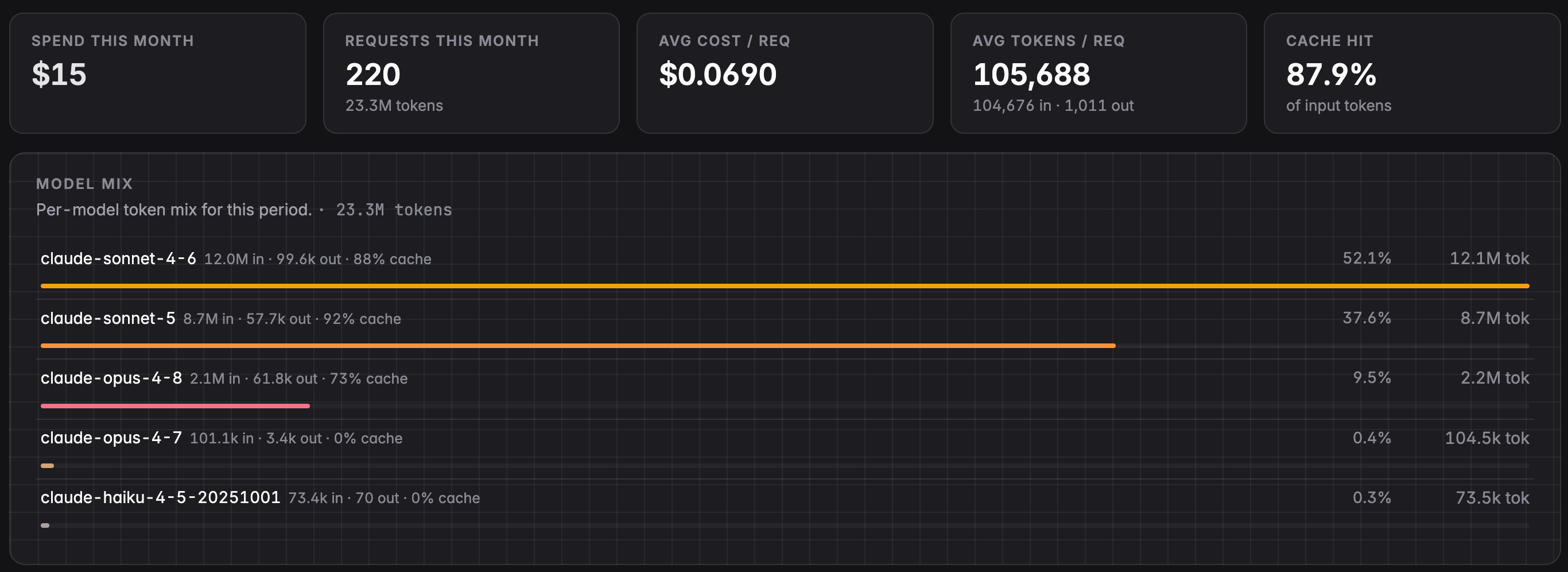
Side Note: In the image above, an 87.9% Cache Hit rate means that 87.9% of all the input tokens I sent to the models this month had already been processed in a previous recent request, allowing the system to reuse that data from its memory rather than processing it from scratch.
Think about it - access to a model is not a competitive advantage when competitors can obtain access to the same model with a contract and a credit card.
But… They cannot download your history. They cannot recreate years of customer interactions, product decisions, engineering knowledge, operational exceptions, research, failures, and recoveries simply by upgrading an API subscription.
Even data ownership is not enough. A decade of information scattered across file shares, SaaS applications, databases, email, ticketing systems, old backups, and documents is not automatically an asset that matters most.
It becomes one when the organization can understand it, govern it, connect it, and make it usable without losing control of it.
That is data gravity.
Bring the Machine to the Data
Dave McCrory coined the term data gravity in 2010. I wrote about it a few months ago, in Data Gravity. The idea was simple: as data accumulates, it gains mass. Applications, services, and compute move closer because latency, throughput, cost, and practicality make distance increasingly painful.
AI makes that gravity stronger.
Moving a few documents into a cloud service is easy. Moving petabytes of proprietary, sensitive, constantly changing enterprise data to whichever model happens to be fashionable this quarter is something else entirely.
Copies become stale. Egress becomes expensive. Security boundaries multiply. Sovereignty and compliance questions arrive. The organization starts building new pipelines to move data away from the systems already responsible for protecting it.
At AI scale, the older assumption that data should travel to compute begins to reverse.
I think the model should travel to the data.
This does not mean everything must remain on-premises. It means the architecture should respect where data lives and avoid unnecessary movement, duplication, and loss of control.
The architecture is not centered on a single model. It is centered on the data layer.
What Everpure Is Building
This is where Everpure’s recent announcements become more interesting than another collection of product names.
The company’s move from storage toward an Enterprise Data Cloud strategy only makes sense if you accept that AI’s limiting factor is not simply access to GPUs or models. It is the ability to locate, understand, govern, and feed enterprise data into those systems.
Everpure Data Intelligence, built from the acquisition of 1touch.io, is intended to discover and classify information across structured and unstructured environments. More importantly, it builds context around that information: what the data represents, where sensitive information exists, who should have access to it, and how records across different systems relate to the same person, asset, customer, or event.
At Accelerate, one public demonstration used an anonymized athlete named Shane Falco, which was either a deliberate reference to The Replacements or evidence that somebody in product marketing and I have watched too many of the same movies.
The system found a heart condition buried inside a PDF, connected it to the athlete’s son in another database, and identified that the son had never been screened.
The model was not the interesting part. The connection was.
A language model can generate a polished paragraph about heart conditions. The value appears when the system knows that this PDF refers to this person, that another record refers to his dependent, that the relationship matters, and that access to both records is permitted.
Everpure Data Stream addresses the next part of the problem. Built with NVIDIA components, it packages the steps required to ingest, transform, vectorize, index, retrieve, and generate from enterprise data. Instead of every customer assembling a RAG pipeline from a collection of models, databases, frameworks, scripts, and open-source projects, the product attempts to provide those capabilities as an integrated service.
Everpure says customers commonly spend two to four months building pipelines before AI can read a single document.
That sounds believable to anyone who has watched an enterprise project spend six weeks deciding who owns the service account.
The two products form a logical pair. Data Intelligence determines what the data is, how it relates, whether it is sensitive, and how it should be governed. Data Stream makes approved data usable by AI applications.
The Real Advantage
The industry has become very good at demonstrating fast AI.
Upload documents. Ask a question. Watch the answer appear. Add an agent. Give the agent a friendly name. Put the architecture on a slide with several arrows, because nothing becomes enterprise-ready until the arrows have gradients.
Production means the answer must come from the correct information. The information must be current. Access must be enforced. Sources must be traceable. Sensitive records must not casually appear in the wrong context. Somebody must know what happens when two authoritative systems disagree.
Anyone can stand up fast AI, but trusted AI is different.
I do not believe large language models are merely parrots. They build internal representations. They solve problems through methods their creators may not yet fully understand. They can use tools, inspect their work, and produce results that would be impossible only a few years ago.
I also do not believe there is a little mind inside the machine waiting for us to ask an interesting question.
The truth is more complicated and more useful.
These systems are powerful statistical machines. They are very capable in the broad middle of human language and knowledge. They become stronger when given tools, external verification, and context based on truth. They also remain fragile at the edges, where the data is sparse, the situation is unusual, and plausibility is not enough.
The future will not belong to the company that selected the perfect model in 2026. The advantage will belong to the organization that knows what data it has, understands what that data means, protects it, connects it, and can safely bring whichever model it chooses to that governed context.
Once you see the machine behind the mirror, the model itself starts to look less like the moat and more like the visitor standing at its edge.
Appreciate you reading.
Dmitry Gorbatov
© 2025 Dmitry Gorbatov | #dmitrywashere
Ah, Dmitry, it seems that criticizing AI for its 'empty mimicry' is actually our hidden denial of our own nature. This mirror frightens us. AI has laid bare the fact that a vast portion of our everyday 'intelligence' is not deep reasoning, but merely a compilation of cultural patterns, polite scripts, and rehearsed phrasing. The only comforting thought is that our 'subcortical chemical processes' are the only processes in the known Universe that have managed to become self-aware and are now debating their own mechanistic nature. There is a peculiar, albeit somewhat ironic, beauty in this.