

People close to me know that I have a very annoying habit of memorizing, remembering, and using movie and TV show lines in normal conversation. I wish I could tell you this is a carefully curated personality trait, but it is probably closer to a long-running defect in the #dmitrywashere operating system. Some people remember birthdays. Some people remember where they parked. I remember a line from a sitcom episode that aired before half the people reading this had a LinkedIn profile.
My two favorite sources are Friends and The Big Bang Theory, which probably says something about me that I am not emotionally prepared to unpack in public.
There is a scene from Friends that has lived rent-free in my head for years, mostly because it captures something deeply human and mildly embarrassing. A salesman is talking to Joey and asks him a question that is both funny and a little too accurate: “Let me ask you one question. Do your friends ever have a conversation and you just nod along even though you’re not really sure what they’re talking about?”

Joey, of course, immediately zones out. Not metaphorically. Not politely. He disappears into that wonderful Joey place where the mouth stays closed, the face stays agreeable, and the brain has clearly left the building.
That was me the first few times I started hearing people talk about MCP.
Not once. Not twice. Everywhere. MCP this. MCP server that. MCP is the future of agents. MCP is the USB-C of AI. MCP is how models connect to tools. MCP is the protocol that will make agentic AI real. MCP is the standard. MCP is the integration layer. MCP is the thing everyone apparently understood already, except somehow nobody had bothered to send me the memo.
So I did what any responsible technology professional does in that situation. I nodded thoughtfully.
The next thing I did was call my son, who is a Data Scientist, and ask him what MCP actually was. After listening to his explanation, I had the uncomfortable realization that he knew more about it than I did, which, naturally, did not feel great. That was just my ego talking, of course. He is way smarter than me.
Then I went away and tried to figure out whether MCP was actually important or whether it was just another acronym that had wandered into the AI conversation wearing a conference badge.
And that brings me to the other sitcom line that kept popping into my head while I was trying to explain this to myself. In The Big Bang Theory, there is a scene where a very drunk Penny says, “I think I owe you …splanation,” clearly attempting to say ‘explanation’ while her brain and mouth are no longer managed by a ‘unified control plane.’
That is exactly how MCP felt to me at first.
I did not need another acronym. I needed a …splanation.
A real one. Preferably in English. Preferably without requiring a PhD in distributed systems, three browser tabs of developer documentation, and someone on YouTube drawing boxes and arrows while saying “obviously” before explaining the least obvious thing I had heard all week.
So this article is my attempt at that …splanation.
After spending time researching MCP, I think it is important. More importantly, I think it is important in a very practical way. It is not the kind of important that requires everyone to become an AI researcher, read white papers at midnight, or pretend that “agentic workflow orchestration” is something normal people say at dinner. MCP matters because AI is moving from something that talks to something that can actually do work, and doing real work requires access to real systems.
That is the part worth slowing down for.
Most people first experienced modern AI as an LLM chat bot window. You typed something in, and the model responded. Sometimes the answer was impressive. Sometimes it was useful. Sometimes it was wrong with the confidence of a man giving directions in a city he has never visited. But the basic pattern was easy to understand. You asked a question. The LLM answered. That was the product experience.
The problem is that most real work does not happen inside a blank chat box. Real work lives in messy places. It lives in documents, calendars, databases, code repositories, CRM systems, ticketing tools, emails, Slack messages, service logs, storage platforms, cloud consoles, spreadsheets, procurement systems, and all the other places where business reality hides after the meeting ends.
That is why the first wave of AI, as magical as it felt, was also strangely trapped. A model could write a beautiful summary of a business problem, but unless you gave it the actual business context, it was still guessing.
An LLM is not programmed to say “Sorry, I don’t know.” So it makes stuff up with proper grammar and punctuation.
It could explain how to troubleshoot an issue, but unless it could inspect the logs, check the configuration, or look at the environment, it was still operating from theory. It could tell you how to prepare for a customer meeting, but unless it could see the account history, the open opportunities, the support cases, the renewal status, and the meeting notes from last quarter, it was basically giving you a very articulate horoscope.
MCP is one of the attempts to fix that.
MCP stands for Model Context Protocol.
The name sounds like it was assembled by people who are very good at distributed systems and very bad at naming things for humans, but the words are actually useful. “Model” refers to the AI model. “Context” refers to the information and tools the model needs in order to be useful. “Protocol” means a standard way for systems to communicate.
In plain English, MCP is a standard way for AI applications to connect to external tools and data sources.
That may sound boring, but boring is often where the real technology changes happen. Nobody gets a standing ovation for plumbing until the plumbing stops working. Nobody thinks about electrical standards when they plug in a night light. Nobody wants to understand every detail of networking just to open a website. Standards become invisible when they succeed, and that invisibility is exactly why they matter.
The analogy people use is that MCP is like USB-C for AI. I know that analogy is already dangerously close to becoming a bumper sticker, but it works well enough if we do not abuse it. USB-C did not make your laptop smarter. It did not make your monitor more creative. It did not make your phone more emotionally available, although at this point I would appreciate it if mine at least tried.
What USB-C did was standardize connection. Instead of every device requiring its own special cable, adapter, dongle, ritual, and small sacrifice to the drawer of dead electronics, USB-C created a common interface.
MCP is trying to do something similar for AI. It gives AI applications a common way to connect to the tools and data they need. The model does not need to know the internal details of every application. The application does not need to build a completely different integration for every model. MCP creates a shared language in the middle.
That middle layer is what matters.
Without something like MCP, the AI world runs into what technical people call the N-by-M problem. Katie Baker wrote about it last year: NxM Problem
If you have ten AI applications and ten systems they need to connect to, you do not want one hundred custom integrations. If you have fifty AI applications and two hundred systems, you definitely do not want ten thousand custom integrations, unless your business model is selling painkillers to integration teams.
The better model is not N times M. It is closer to N plus M. Each AI application learns how to speak the protocol. Each tool or data source exposes itself through the protocol. Once both sides understand the same standard, the number of custom connections drops dramatically.
This is the point where MCP starts to become more than an AI developer convenience. It starts to look like infrastructure.
To understand how it works, you do not need to become a protocol engineer. You just need to understand three roles: the host, the client, and the server.
The host is the AI application the user interacts with.
That could be Claude Desktop, ChatGPT, Cursor, Visual Studio Code, or an internal enterprise assistant with a name like Atlas, Navigator, Compass, or whatever else the branding team selected after eliminating “Dave.” The host is where the experience lives. It is where the user types the request, where the model reasons, and where the answer or action comes back.
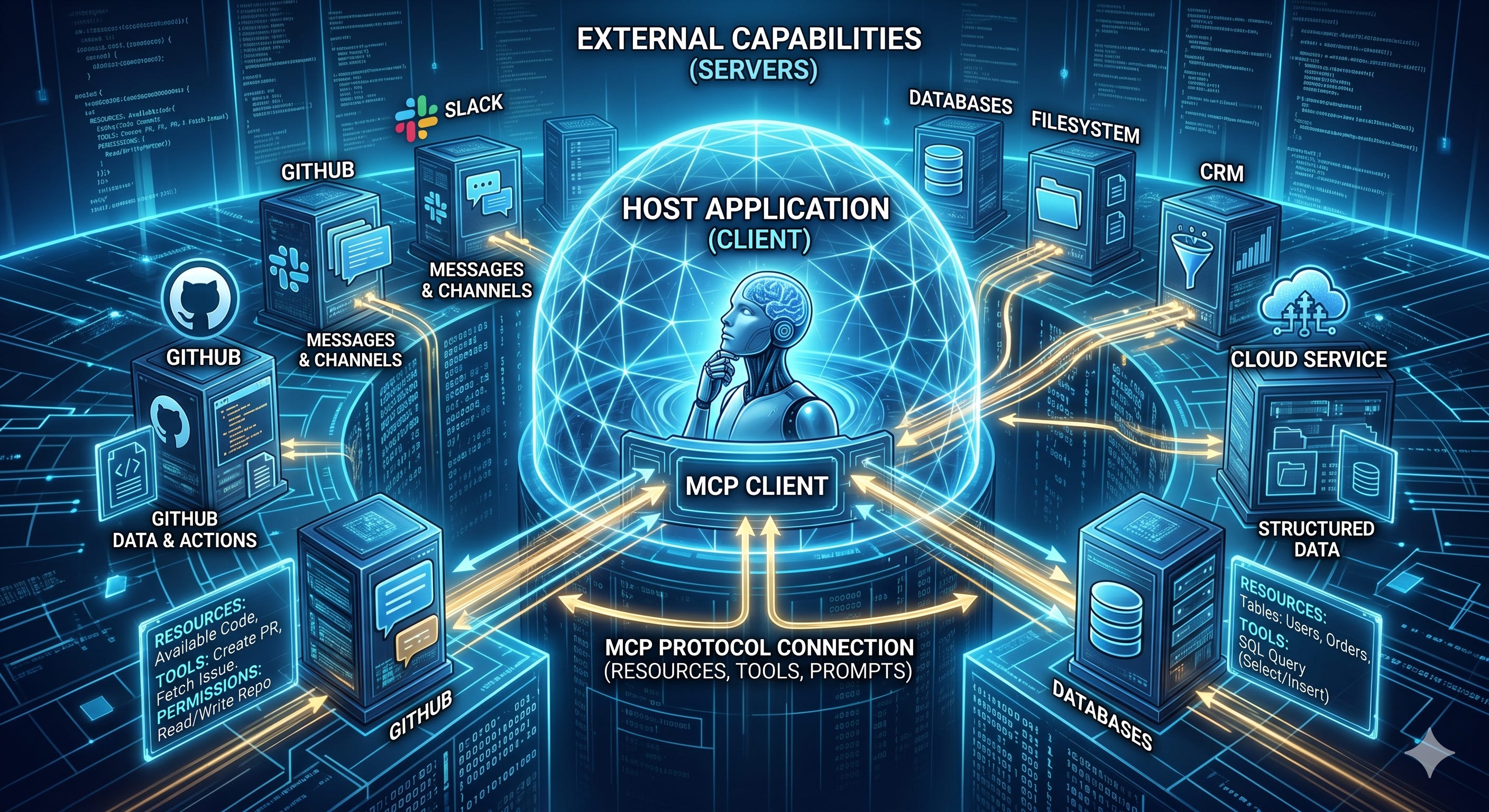
The client lives inside the host and manages the connection to an MCP server.
You can think of it as the part of the application that knows how to speak MCP on behalf of the model. It handles the conversation between the AI application and the external capability.
The server is the wrapper around a data source.
There might be an MCP server for GitHub, another for Slack, another for a database, another for a filesystem, another for a CRM, another for a cloud service, and eventually one for every system that vendors decide must now be described as “AI-ready” in a press release.
The server’s job is to expose what it can provide in a way the AI application can understand. It might say, in effect, “Here are the documents I can make available. Here are the actions I support. Here is the format you need to use if you want to call one of those actions. Here are the permissions required. Here is the result you can expect back.”
That is where the value appears. The AI application does not need to understand every internal detail of GitHub, Slack, Salesforce, Postgres, Kubernetes, or your company’s deeply loved but spiritually exhausted internal ServiceNOW ticketing system. It needs a standard way to discover and use the capabilities exposed by those systems.
MCP gives it that standard way.
The protocol itself is built around a few core ideas that are easier to understand than the terminology makes them sound. MCP servers can expose tools, resources, and prompts.
Tools are actions the model can ask to perform.
A tool might search a database, send a Slack message, create a support ticket, run a test, update a CRM record, query an API, or retrieve the status of a system. Tools are where the AI starts moving from “I can answer your question” to “I can help complete the task.”
Resources are information the model can read.
These could be files, documents, schemas, database records, logs, API responses, or other pieces of context. Resources matter because AI without context is mostly a very confident intern on the first day of work. It may be talented, it may be fast, and it may be enthusiastic, but it does not know where anything is.
Prompts are reusable instructions or workflows.
That sounds small, but it is not. In business, consistency matters. You may not want every user inventing their own version of “analyze this account,” “review this code,” “summarize this incident,” or “prepare this forecast update.” A prompt can define how a model should approach a task, what standards it should follow, what inputs it should consider, and what kind of output is expected.
Tools let the model act.
Resources give the model context.
Prompts help shape the model’s behavior.
That combination is what makes MCP useful.
Let’s make this practical. Suppose you ask an AI assistant to help prepare you for a customer meeting. Without access to your systems, the assistant can give you a generic meeting prep template. It can tell you to understand the customer’s goals, review previous discussions, identify risks, prepare discovery questions, and align to business outcomes. None of that is wrong. It is also not especially magical. It is the kind of advice that sounds helpful until you realize it could apply to almost any meeting with almost any customer in almost any industry.
Now imagine that same assistant has controlled access to the right systems through MCP servers. It can read the meeting notes from prior briefings, pull the current opportunity data, review support tickets, check the renewal timeline, inspect open technical issues, summarize the customer’s stated initiatives, and identify where the account team may be telling itself a story that is more optimistic than the facts support. It can then generate a briefing that is not generic at all. It is specific, grounded, and useful.
That is the difference between AI as a writing assistant and AI as a work assistant.
This is why MCP keeps showing up in conversations about agents. An agent is not just a chatbot with a better title. An agent is expected to reason through a goal, choose tools, gather information, take steps, observe results, and continue until the task is complete or until it needs human help. That requires a standard way to connect reasoning to action.
MCP is one of the strongest candidates for that standard layer.
This is also where the MCP conversation stops being abstract for anyone running Everpure Fusion.
It is one thing to say that MCP allows AI agents to connect to enterprise systems. That sounds interesting, but it can still feel like one of those technology ideas that lives safely inside a product roadmap, an architecture diagram, or a conference session where the coffee is somehow both expensive and terrible.
It becomes much more practical when you look at what Everpure is doing with the Everpure Fusion MCP Server. I can almost guarantee that you will not click the link below, so I read it for you. But that will be in Part 2. I already drafted it, but I want to be respectful of your time. Not all of my readers are Everpure customers (yet).
So that is my MCP “…splanation,” at least the Part 1 version. MCP is not the robot, and it is not the magical brain that suddenly makes every workflow intelligent. It is the standard connection layer that helps AI move from “I can answer your question” to “I can interact with the systems where your work actually happens.” That may not sound glamorous, but neither does plumbing, electricity, networking, or storage until something important depends on it. And that is why MCP matters. Because the next phase of AI will not be defined only by which model sounds the smartest in a chat window. It will be defined by how safely, consistently, and usefully those models can connect to real tools, real data, and real workflows.
In Part 2, I will bring this closer to home and look at what this means for Everpure Fusion, because once AI starts needing context from infrastructure, the way we manage that infrastructure starts to matter a lot more.
Appreciate you reading.
Dmitry Gorbatov
© 2025 Dmitry Gorbatov | #dmitrywashere