

I am fully aware that once I publish this, I will be accused by some readers of being against progress, an old geezer, gramps, or something along these lines.
We hear this often. The younger generations are not capable of performing simple tasks without their phones and computers. The schools no longer teach our children to read and write in cursive. Some joke that this is the best encryption tool available. Things like reading analog clocks, paper maps, memorizing math formulas or poetry are not the skills they possess. When you point it out, people shrug it off as a nuisance. Why do I need to remember all this stuff when my phone can tell me the time, give me directions and solve any math problem that I need? With the help of AI bots, I can write my essays, resumes, cover letters, emails and code. I can generate music, videos and images. I don’t need to know how to do it. There is no reason for that.
My mind goes to 2008 when the movie WALL-E came out. It felt almost grotesque. All these people just floating around the spaceship, well fed and hydrated, with the computer screens right in front of their faces. We said to ourselves, this is not going to happen. We are in control. Are we? Really?
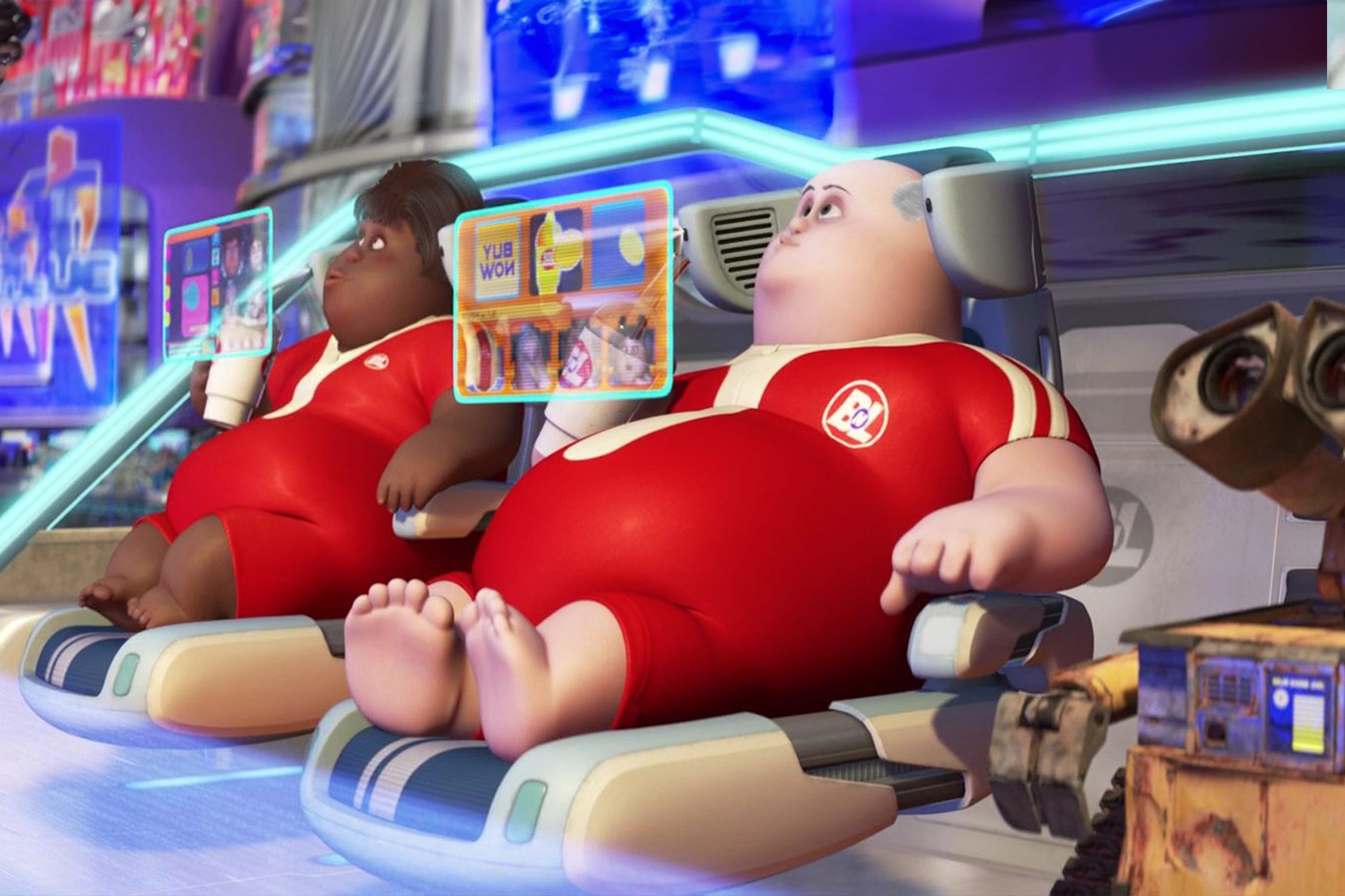
There is a scene in the movie where a woman (I think her name was Mary) is riding a monorail across the deck of the starship called Axiom. She has a holo-screen hovering just a few inches in front of her face. And this is where every passenger on this ship has their screen too. A small robot bumps into her chair by accident and knocks the screen away from her face. As a result, Mary has an unobstructed view of the world surrounding her. Her eyes dilate slowly. She reacts as if she is seeing the world for the first time. She gets out of her chair, looks around and says: “I didn’t know we had a pool!” As I think about it, the people who wrote the screenplay were trying to tell us something 18 years ago. And it was not the chair. I think they were trying to show us cognitive decline. We did not get weaker. We just stopped knowing the shape of the place we are standing in.
Think about a New York City subway car, or an airport gate area, a doctor’s office, or any public place where you can participate in my personal favorite sport, people watching.
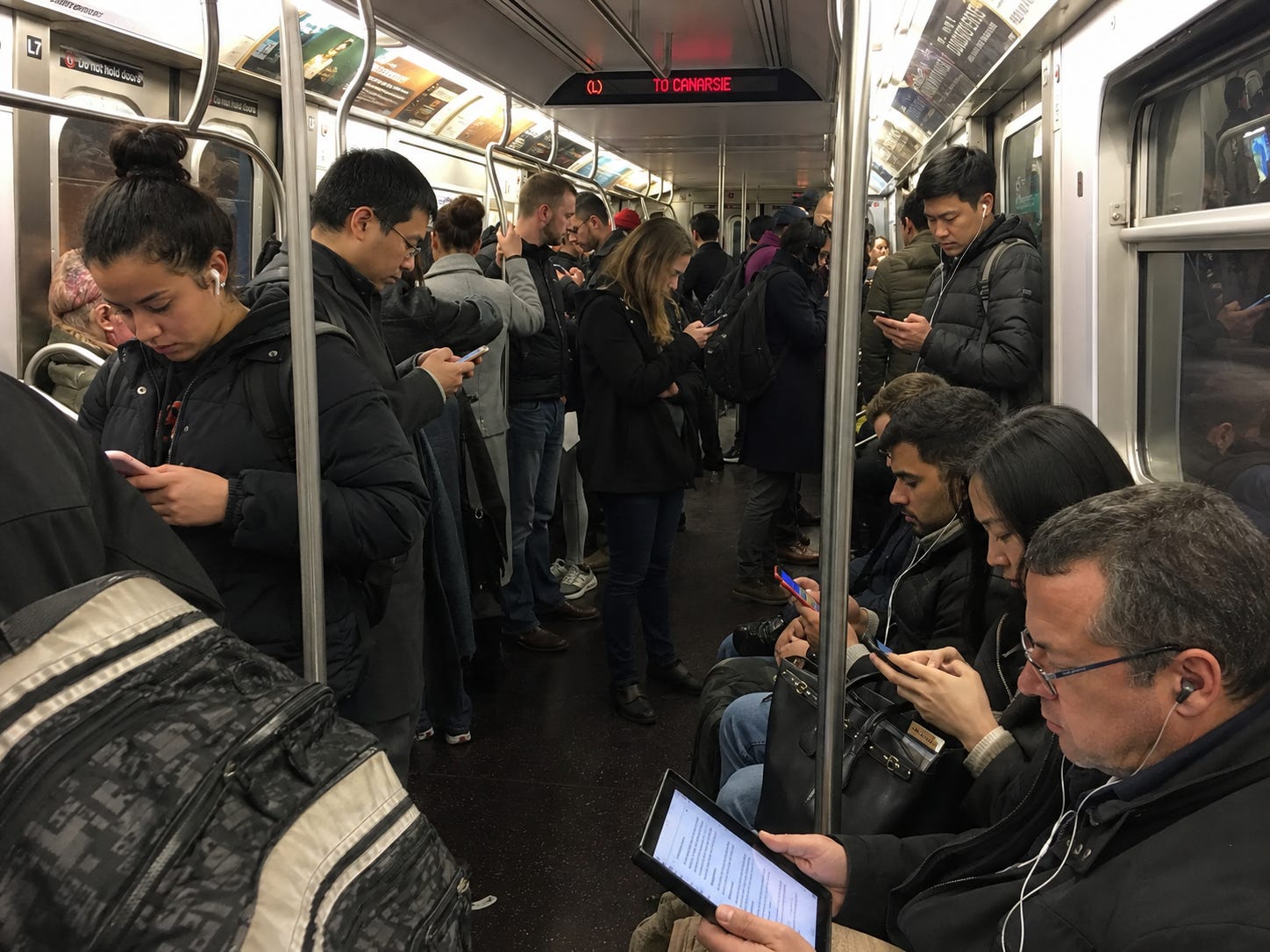
I don’t want to be insensitive, but what happened to human eye contact, to a conversation?
What if there was a cyber crash tomorrow? I know it’s a dark thought, but stay with me for a few minutes here.
Massive power grid failure, internet outage, cell services down. The older generation might be able to function, but I fear for younger people.
In my line of work, the engineers are required to obtain certifications. The exam happens in a proctored environment with no reference material. You either have to know how stuff works, or you have to memorize certain things. Sometimes even I question it. Why memorize when I can easily go and look it up on the support website or just ask an AI agent?
But the human brain is like a muscle and it needs to be trained to remain strong and agile. Reading, memorizing, building and creating things, writing in cursive, all of that helps.
This is not a new thought at all. Many people are worried about the consequences of relying on technology too much.
Back in 2011, a study published in Science showed that if people know that some fact is stored on the computer, their brain doesn’t bother to store it “locally.” They just remember where to look.
London cab drivers memorize over twenty-five thousand streets in the city. That part of their brain grew physically larger. Well, this sounds good, but it is not entirely accurate. In technical terms, the gray matter in the hippocampus simply shifted towards the back, which is redistribution, not growth. When they retire, it starts to drift back, but it never fully gets there. And here is the funny part. Working cabbies are worse than the rest of us at learning new visual things. Retired ones are not. So they lost something and got something back at the same time. Use it or lose it, sure. But also use it and lose something else. Give people GPS and the navigation circuitry in their brains works a lot less.
Researchers at MIT put sensor caps on 54 subjects (three groups of 18) and told them to write an essay. One used ChatGPT, one was allowed to use a web search engine, and the last was told to write it without any helper tools.
The results were incredible. The brain-only group scan showed dense and balanced activity. The brain was lit up like a Christmas tree. The group with the search engine showed significantly less activity, and the ChatGPT group showed the weakest activity of all. Then the researchers took the AI away and told that group to write unaided, and their brains stayed quiet. They couldn’t even quote the essays they supposedly just wrote. 83% of them. In fancy terms, this is called cognitive debt. Here is a quote from the Q&A section of the study. It is almost funny.
“Is it safe to say that LLMs are, in essence, making us ‘dumber’? No! Please do not use the words like ‘stupid’, ‘dumb’, ‘brain rot’, ‘harm’, ‘damage’, ‘passivity’, ‘trimming’ and so on. It does a huge disservice to this work, as we did not use this vocabulary in the paper, especially if you are a journalist reporting on it.”
Most recently, in 2025, there was another study published in The Lancet. They studied a group of endoscopists who used AI to assist with spotting precancerous growths in the colon. When AI was taken away, the doctors’ own detection rate fell by six percentage points. Just think. Seasoned specialists made weaker by the tool that was designed to help them.
The prosecution rests!
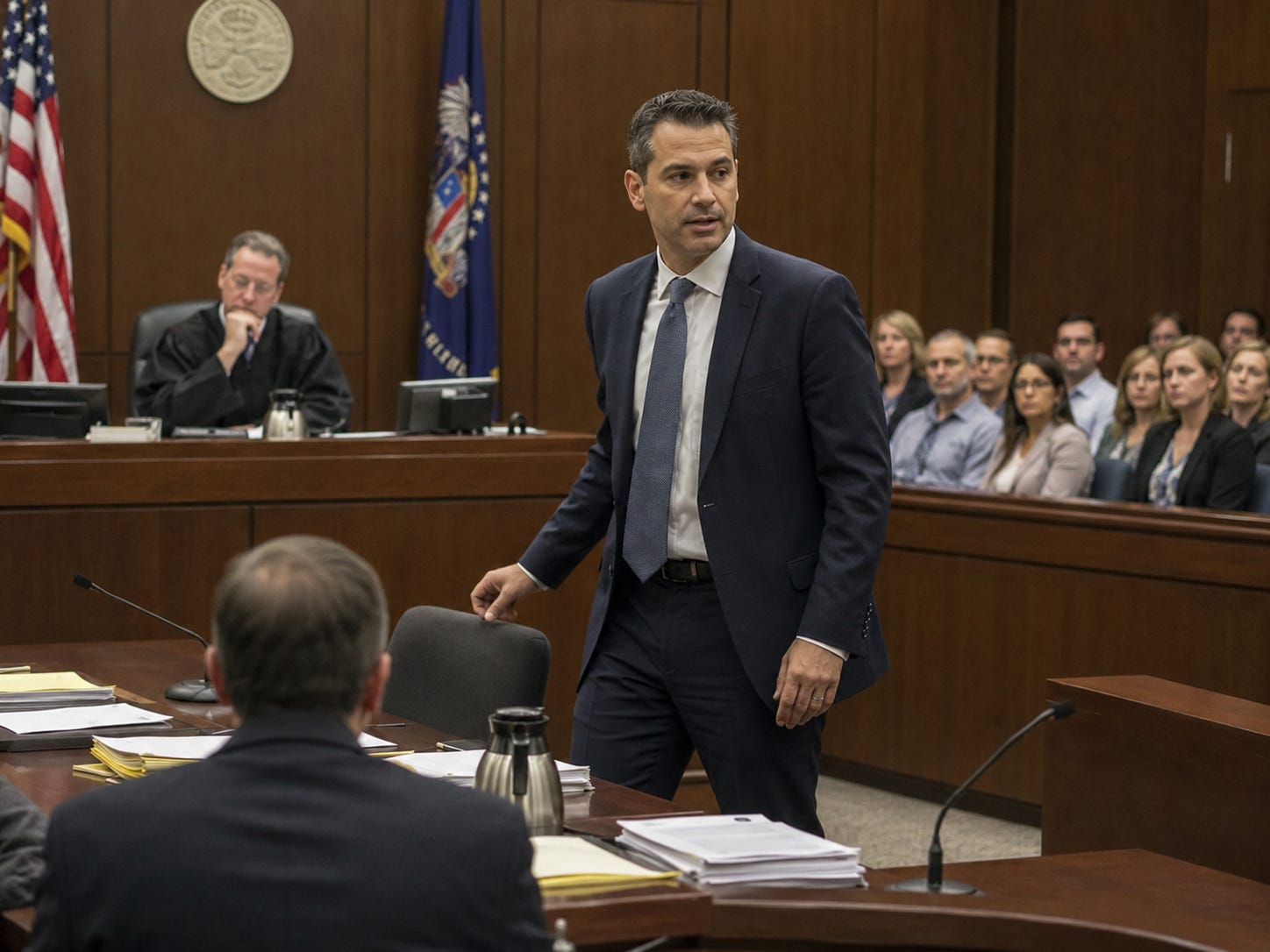
I could probably end this article here, but that would be a huge disservice to my readers. The prosecution has spoken, now it’s time for the defense lawyers. Right?
Instead of being lazy, I decided to actually read the studies instead of only reading sensationalized summaries. That was a huge mistake on my part because it completely ruined a really good article.
Well, the MIT study is not peer reviewed, and the 2011 study has failed to replicate twice. Even the colon cancer paper, the one I just used as my closing argument, is called “hypothesis-generating” by its own authors, and three studies have since gone looking for that effect and none of them found it. One of those was co-authored by the same senior author, across five thousand colonoscopies.
So I could just stop here and tell you that this is all nonsense. But that would be its own kind of lazy. This is not how we roll in this shire.
Underneath all of it, there are some really cool findings. People who asked AI to explain things to them still had the material a week later. People who asked the AI bot to write it for them lost the gains the moment the tool was taken away.
Same AI tool, different result. It is all about what you asked it to do.
Every generation has run this experiment before. Socrates thought that writing things down would ruin memory. We only know about it because Plato wrote it down. Some guy in Switzerland in the 16th century was worried about the abundance of books. He thought it would be harmful. Then radio, TV, comic books, video games. And, oh my, calculators!! There was a study that showed kids who used calculators alongside traditional instruction improved their pencil and paper math skills.
The tool didn’t replace the teaching, it complemented it.
Let’s go back to our spaceship, the Axiom. I realize now that I used that movie unfairly. At a test screening in 2007, the director found out that half the audience walked out thinking the humans would not survive back on Earth. So he had Pixar build an entire end credits sequence, showing the people and the machines rebuilding the planet together. They wanted to tell the audience it was going to be all right.
And in the movie itself, the whole recovery takes one afternoon. Mary’s screen goes dark and she sees John sitting next to her. The ship captain stands up on his own two feet for the first time in his life. Nobody on that spaceship is broken. They just need a little nudge and they will be just fine.
So I am not going to tell you to get rid of your phone. I still ask the AI to explain things to me, and I am not giving that up. This article would have many more grammar and spelling errors without the help of AI. Those certification exams, in a room with no reference material, are miserable and we complain about them every time, but we also notice that the things we had to memorize are the things we still remember.
Everything in moderation, even moderation itself. Let the machine do the boring part. Keep doing the part you would miss. Read a book once in a while, not on a tablet, a real paper one. Right? Take the wrong turnpike exit on purpose and find your own way back, write something by hand and see how much worse your handwriting has become.
It is nice to know your way around the ship you live on.
And every so often, let something bump your chair.
I appreciate you reading.
Dmitry Gorbatov
© 2025 Dmitry Gorbatov | #dmitrywashere
I bought a cursive handwriting book recently… it’s a process. Wasn’t great at it as a kid either… I blame dyslexia… and spell check.