

Back in February, I wrote that I had never been to Pure//Accelerate.
This year, I still am not in Las Vegas.
I watched the Everpure Accelerate 2026 opening keynote live from my home office, which turned out to be a different kind of vantage point. Not better than being there. Not worse. Just different.
You do not get the hallway energy. You do not get the sponsor booths. You do not get the accidental conversations that happen while looking for coffee (or tea in my case). You do not get to read the room in the same way. You are not surrounded by the noise, the music, the badge lanyards, the customer reactions, or that strange conference feeling where everyone is tired and energized at the same time.

A keynote viewed remotely has to work harder because the production does not carry you in the same way. If the speakers are just reading slides, you feel it immediately. If the story is thin, the distance makes it thinner. If the message is only a collection of announcements, you start checking email.
But if the story is real, the distance does something interesting.
It removes some of the theater.
You are left with the words, the pacing, the ideas, and whether the people on stage actually believe what they are saying.
This morning, the parts that landed with me were not the parts that felt the most polished. They were the parts where the keynote stopped sounding like a keynote and started sounding like people trying to explain a real shift in the industry.
For me, the strongest moments came from Charlie Giancarlo, Chadd Kenney, Shawn Rosemarin, and the NVIDIA conversation. Not because they had the most slides. Not because they had the most numbers. They landed because they are storytellers.
That matters more than we sometimes admit in enterprise technology.
A slide reader can tell you what a product does.
A storyteller can tell you why the product had to exist and why it matters to the customer or partner.
There is a difference.
And this morning, the difference mattered.
Charlie’s most important line came early, and it changed the shape of the keynote. He said he was not going to talk about data storage.
He was going to talk about data.
For a storage company’s major customer event, that is not a small pivot.
It would have been easy for Everpure to spend the morning celebrating the familiar things. Growth. Customer count. Market share. Flash leadership. Subscription run rate. Fusion adoption. Gartner recognition. Net Promoter Score. Performance numbers. Efficiency numbers. All of that was there, and all of that matters.
But the real keynote was not about proving that Everpure is good at storage.
The real keynote was about arguing that storage is no longer the highest-level conversation.
Data is.
That is where the rebrand from Pure Storage to Everpure starts to become more than a name change. A company called Pure Storage can be excellent at arrays, controllers, upgrades, density, performance, and simplicity. A company called Everpure has to earn the right to talk about the enterprise data cloud, and that is a much larger promise.
It is also a much riskier promise.
Because once you move north of storage, you are no longer talking only about where data lives. You are talking about who controls it, who understands it, who governs it, who protects it, and who gets to use it.
That is where Charlie’s message became interesting.
His argument was that the enterprise has spent decades living in an application-centric architecture. ERP had one version of the business. CRM had another. ServiceNow had another. HR systems had another. Analytics platforms copied data out of all of them. Data lakes were built to make sense of the mess. Now AI agents are being asked to reason across that same fragmented landscape.
That is the problem.
Not AI in theory. AI on top of fragmented truth.
We have all seen some version of this. The definition of a customer changes depending on which system you ask. The data in one application does not quite match the data in another. A report is technically correct, but only according to one source. A copy was made for analytics, another for backup, another for a project, another for a data science team, and one more because someone needed it urgently two years ago and nobody knows if it is still being used.
Now imagine asking an AI agent to act on that.
That is where the phrase “Data Primacy” becomes more than keynote language.
From what I understood this morning, Data Primacy is Everpure’s argument that data should no longer be trapped inside applications as a secondary object. The data itself, along with its context, relationships, governance, and sources of truth, has to become primary. Applications still matter. Workflows still matter. SaaS still matters. But the enterprise cannot keep allowing every application to define its own version of reality and then expect AI to make intelligent decisions across the pile.
That is not sustainable.
One of the strongest lines from Charlie was the idea that every vendor wants your data.
Every SaaS vendor wants your data.
Every analytics vendor wants your data.
Every AI vendor wants your data.
But what they really want is not just the data. They want the context.
They want the meaning.
They want to know how a customer in one system relates to a contract in another, a support case in another, an invoice in another, a shipment in another, a security policy in another, and a business outcome somewhere else entirely.
In the AI era, context is the new land grab.
That is the sentence I kept coming back to during the keynote.
Everyone wants your data, but the bigger fight is over who owns the context.
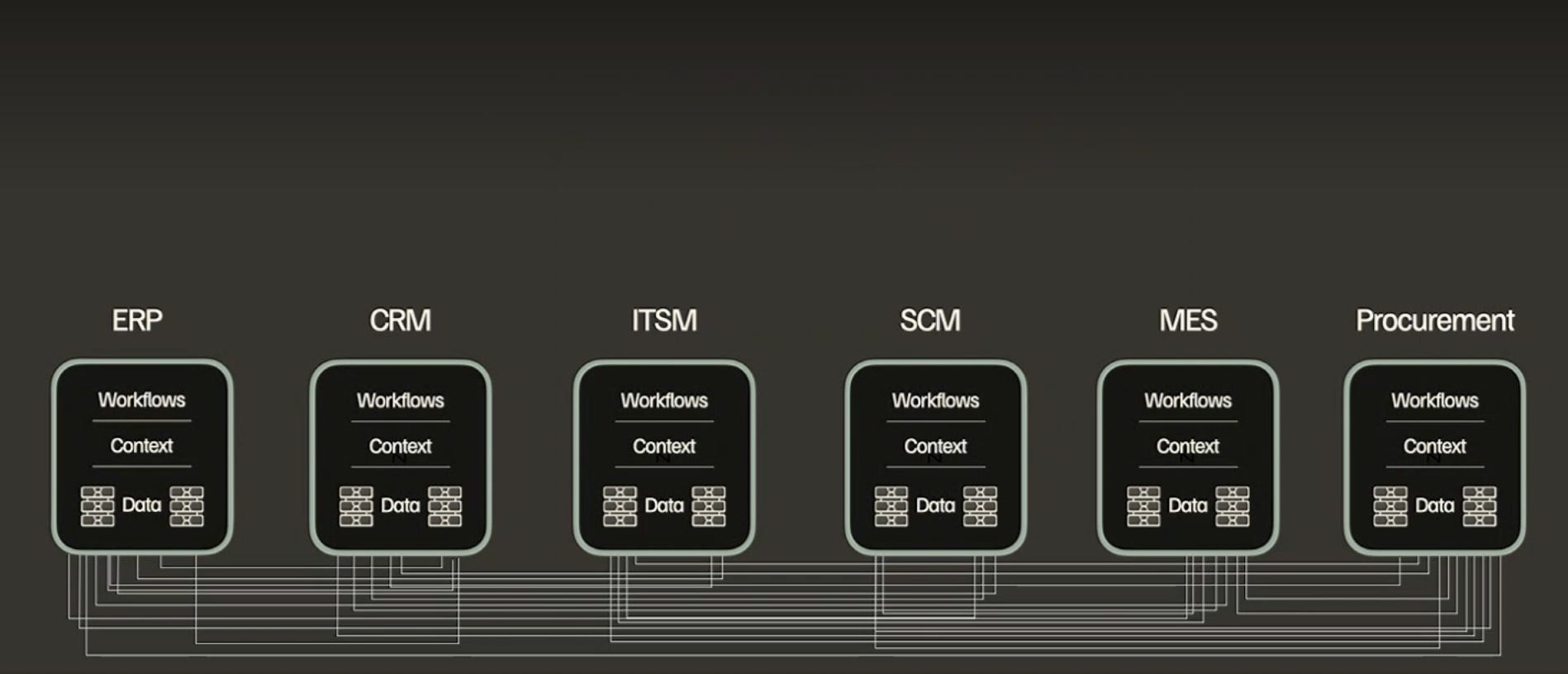
That is why this morning did not feel like just another AI infrastructure pitch. It felt like Everpure trying to move the conversation from managing arrays to managing truth.
That is a big claim. It needs proof. And that is where Chadd Kenney’s part of the keynote mattered.
Chadd is one of those speakers who can make infrastructure feel like an actual story instead of a list of capabilities. That is not easy. Storage features can get very technical very quickly, and if you are not careful, everything turns into a blur of replication, snapshots, policies, performance, controllers, and acronyms.
But Chadd framed the platform in a way that made sense.
First, the unified data plane stores the data. Then the intelligent control plane governs and operates it. Then the universal data intelligence layer helps understand it. Together, those pieces create a different operating model.
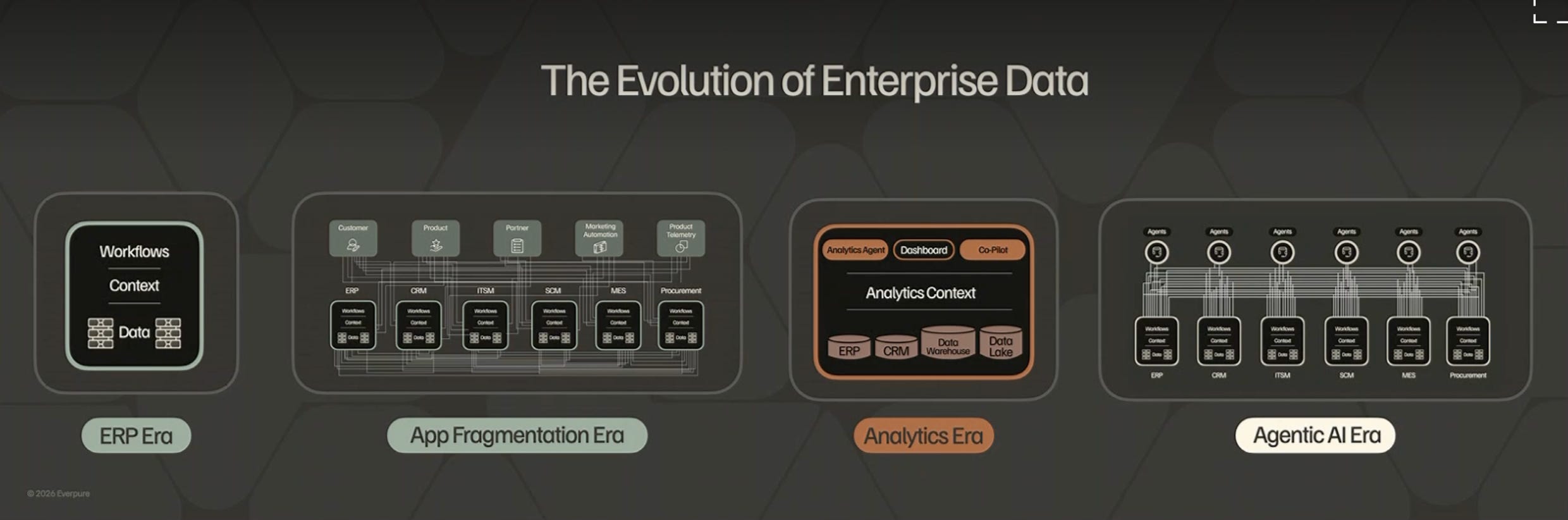
That phrase, operating model, is important.
Because the most interesting part of the demo was not just that Fusion can automate tasks. It was that Everpure is trying to change the relationship between people and infrastructure.
The old world asks humans to be perfect by hand.
Log into this array. Check that policy. Fix that snapshot setting. Compare it to the spreadsheet. Make sure the production workloads are covered. Exclude dev and test. Check compliance. Update the retention period. Open the change. Wait for the window. Hope nobody missed one.
We have normalized that kind of work for years.
Then we call it operational discipline.
Sometimes it is. But sometimes it is just human beings being forced to compensate for systems that do not understand intent.
The Fusion demos showed something better. Define the policy once. Attach intent to the workload. Let the control plane detect drift. Let it show violations. Let it recommend a fix. In some cases, let it act. In other cases, keep the human in the loop, but stop making the human do repetitive work that the platform should be able to understand.
The ransomware snapshot example was a perfect illustration. A customer mandate changes retention from fifteen days to thirty days. In many environments, that becomes a manual chase across infrastructure. In the keynote demo, it became a policy problem, a compliance view, a remediation path, and an audit trail.
That is what infrastructure teams actually need.
Not another dashboard that tells them something is broken.
A system that understands what “correct” looks like and helps keep the environment there.
The workload mobility demo made the same point from a performance angle. If the platform can see that a workload is trending toward a service level violation, recommend a better placement, validate the move, and relocate that workload without the application owner noticing, that is not just automation.
That is infrastructure keeping a promise quietly.
And quiet matters.
The best infrastructure usually disappears. Nobody sends a thank-you note because latency did not spike. Nobody opens a champagne bottle because a replication policy worked. Nobody celebrates the outage that did not happen. But those invisible wins are the difference between a team that spends its life firefighting and a team that gets to work on the next thing.
That is why the Active Cluster for File demo also worked. Synchronous replication for file sounds technical, and it is. But the emotional value is simple. When something fails, the business does not want a heroic recovery story. It wants no story at all.
The workload quietly packed its bags and moved.
That line stayed with me because disaster recovery should be boring. Boring is the goal. Boring means the policy worked, the automation worked, the architecture worked, and the humans did not have to assemble on a bridge call at 2 a.m. to save the day.
Then Shawn Rosemarin took the keynote into the AI conversation, and again, the strength was in the framing.
The bottleneck stalling AI is not compute. It is not models. It is not tooling.
It is data.
That is the part of the AI conversation that I think many customers are starting to feel more clearly. For the last few years, the market has been obsessed with models and GPUs. That made sense. There was a lot to understand, and the infrastructure requirements are real. But most customers are not trying to build the next frontier model. They are trying to unlock the intelligence that already exists inside their own business.
Their documents.
Their contracts.
Their transactions.
Their support history.
Their clinical records.
Their policies.
Their engineering files.
Their internal knowledge.
Their institutional memory.
That does not become useful just because someone points a model at it.
It becomes useful when the data is prepared, classified, curated, governed, indexed, vectorized, and delivered with the right context at the right time.
That is why the Everpure Data Stream announcement with NVIDIA mattered. The message was not simply, “We can feed GPUs fast,” although performance absolutely matters. The more important message was that enterprise AI needs a way to make data AI-ready without creating another silo, another copy, another stale version of the truth.
Shawn made the point clearly: other vendors want you to copy your data into their system. But a copy is always behind.
That is such a simple sentence, but it carries a lot of weight.
A copy has to be protected.
A copy has to be governed.
A copy has to be reconciled.
A copy has to be secured.
A copy can drift.
If AI is going to answer questions, automate workflows, make recommendations, or support decisions, stale context is not just inefficient. It is dangerous.
That is where the NVIDIA conversation added credibility. The point was not just that Everpure has a partner logo on a slide. The point was that AI has become a full-stack infrastructure problem. Data has to move efficiently. GPUs cannot sit idle waiting for bytes. Inference needs low latency and quick access to the right information. Agents need context. Networking matters. Storage matters. Hardware matters again.
I liked the line about hardware being cool again.
I liked it because it is funny, but also because it is true.
For years, parts of the industry talked as if infrastructure had become invisible. Cloud abstracted it. SaaS hid it. Software ate the world, and many people acted as if the physical layer was someone else’s problem.
AI ended that illusion.
When customers are investing serious money in GPUs and trying to build real AI capability, storage is not a commodity. Networking is not plumbing. Metadata performance is not trivia. Power is not someone else’s concern. Operational excellence is not optional.
The physical world is back in the strategy conversation.
Maybe it never left. Maybe some people just stopped looking.
That is why the keynote worked for me, even from my home office.
Not because every demo was relevant to every customer. Not because every phrase was perfect. Not because I think one keynote answers every question. That is what the next two days are for.
It worked because the best speakers were not just announcing things. They were connecting the dots.
Charlie explained why the application-centric model is running out of room.
Chadd showed what it looks like when infrastructure starts operating from intent instead of manual heroics.
Shawn connected AI success back to data readiness instead of model worship.
The NVIDIA conversation reminded everyone that AI is not magic. It is infrastructure, data movement, context, governance, and execution.
That is a story.
And in enterprise technology, the story matters because customers are not just buying features. They are buying a way out of the mess they are already in.
The mess is fragmentation.
AI did not create that mess, but AI is making it impossible to ignore.
That may be the real takeaway from day one of Accelerate. The AI era is forcing enterprises to confront the data architecture choices they have been living with for decades. The old model was manageable when humans were the ones reconciling the gaps. It becomes much more dangerous when agents begin acting on top of those gaps at machine speed.
That is why Everpure’s move toward Data Primacy is worth paying attention to.
It is not just a product direction. It is a point of view.
The application should not own the truth.
The copy should not become the truth.
The dashboard should not pretend to be the truth.
The enterprise needs to own its data, understand its context, govern its use, and make it available to applications, analytics, and AI in a way that is coherent and trustworthy.
That is easy to say and very hard to do.
But this morning, for the first time, I felt the full shape of what Everpure is trying to become after the rebrand. Not just a storage company with a new name. Not just a platform company using AI language because everyone has to. But a company trying to move the enterprise conversation north of storage and into the question that will define the next decade:
Who owns the context of your business?
Because everyone wants your data.
The companies that win will be the ones that know what it means.
I appreciate you reading.
Dmitry Gorbatov
© 2025 Dmitry Gorbatov | #dmitrywashere